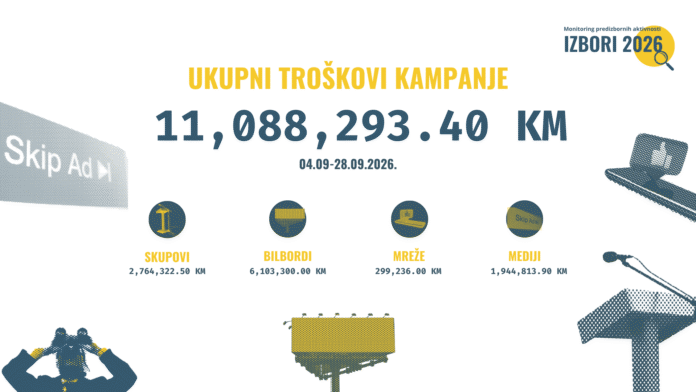
Sarajevo, 1 October 2026 – Political parties have so far spent approximately 11.1 million KM on billboards, media advertising (television and print), Meta company ads, and pre-election rallies, according to preliminary monitoring data conducted by Transparency International in BiH. According to these data, the largest amounts were spent by SNSD (1.8 million KM), followed by SDA (1.3 million KM), SDP BiH (1.1 million KM), and PSS (around one million KM). Billboard advertising cost around 6 million, pre-election rallies 2.8 million, while the value of advertising in the largest media outlets amounts to 1.9 million KM. Additionally, according to Meta company data, around 300,000 KM has been spent on online ads so far.
However, these data are not final and do not include the costs of advertising and pre-election rallies in the final stretch of the election campaign. To all this must be added numerous programmes and other promotional content in the media that had the character of paid promotion but were not marked as such, and their value amounts to almost one million KM. Also, in previous years parties reported significantly lower costs than actual because they could not justify such high costs with legal sources of financing, and according to TI BiH data, for the last local elections alone they concealed at least 2.6 million KM.
The role of public broadcasters in the election campaign
A special role was played by public broadcasters that followed current officials in official-capacity campaigning and gave them significant space in news programmes. Although they were not shown as candidates, a total of 2,176 items were recorded on the three public broadcasters that by their content indicated the promotion of their views and policies, and 64% of such content was recorded on RTRS. According to measurements by the agency engaged by TI BiH, this public broadcaster gave SNSD officials and candidates as much as 28 hours of programming, and all together they had 1,382 appearances in news programmes so far.
The Prime Minister of RS, Savo Minić, who is also a candidate in the elections, was shown as many as 191 times, which lasted a total of more than 5 hours of programming. His opponent Branko Blanuša was shown 5 times for a duration of 69 seconds (the figure does not include election chronicles). Željka Cvijanović, who is again a candidate for member of the Presidency of BiH, has so far been shown 101 times through 4 hours and 17 minutes of programming. Broadcasting of statements by her opponent Nebojša Vukanović, who is a member of parliament, on RTRS has not been recorded since the start of the campaign, while her other opponent Marinko Božović was shown three times, or a total of 36 seconds.
Considerably fewer such items were recorded on the other two public broadcasters (FTV 26% and BHRT 10%). In FTV news programmes, the most space—45%—was given to current officials who are members of SDP (177 appearances, a total of 2 hours and 38 minutes), as well as NIP (77 appearances, 38 minutes of programming) and SDA (a total of 81 appearances, 33 minutes of programming). BHRT gave the most space in a smaller number of items to current officials of SDP, SDA, NIP, SNSD, and HDZ without significantly giving more space to officials of any one party. These phenomena were certainly influenced, in addition to the editorial policy of public broadcasters, by the official-capacity campaigning of current officials who increased the number of public appearances during the election campaign, while public broadcasters follow and report on the work of institutions.
Official-capacity campaigning and abuse of public resources
In the context of official-capacity campaigning, TI BiH observers monitored 72 public institution events, and at 77% of these events election candidates were present. In 35% of cases political messages were sent, but in some cases there were no sanctions, although it is prohibited by law to conduct campaigning at events financed by public funds. One example that went unsanctioned is TI BiH’s complaint regarding the promotion of HDZ candidates at the commemoration of the “Maestral” operation in Jajce. TI BiH raised the issue that the programme host introduced Darijana Filipović as an HDZ candidate, while the president of the “13. Rujan” Association, which is financed from the budget and organizes the event, named by name the candidates of this party for different levels of government.
TI BiH observers recorded over 2,850 examples in the last three months that can be characterized as the use of public resources for the election campaign. So far, 78 complaints covering 136 different phenomena have been submitted to the CEC, which largely relate to the abuse of public resources and premature campaigning. The CEC has so far imposed 271,000 KM in sanctions on political entities based on TI BiH complaints. However, the CEC’s monetary fines did not have a deterrent effect on key actors, because violations were repeated and became more frequent as election day approached, nor did they influence a change in political culture and public perception, because sanctions for the abuse of public resources were absent and most were reduced to premature campaigning.
This approach by the CEC relativized the responsibility of officials, because fines for premature campaigning were perceived by the public as a procedural violation and did not attract much media attention, while abuses of public funds for political promotion and vote-buying went almost completely unpunished. According to CEC records, of 85 complaints received so far from various entities exclusively for abuse of resources, only BiH Finance Minister Srđan Amidžić has been sanctioned so far, and that was based on a TI BiH complaint. Six more sanctions were issued to SNSD, PSS, BHI, and NPS for delivering political speeches at public events and promoting public works on social networks, where the CEC saw elements of both premature campaigning and abuse of resources.
A particular problem is the CEC’s refusal to sanction mass occurrences of indirect vote-buying with public money through the distribution of one-off payments to different categories of citizens. So far, TI BiH has recorded over 78 million KM distributed through one-off payments to different categories. Most often these are one-off assistance to pensioners, social and other categories timed before elections. Although there is a legal prohibition on indirect vote-buying through the distribution of one-off payments (except for regular and planned payments), the CEC has so far rejected all TI BiH complaints with the argument that these are regular or planned payments.
The largest amount, almost 47 million, was distributed by the RS Government for one-off assistance to pensioners, students, and pupils, although this was not planned at all in the original budget. The CEC concluded that there was no abuse of public resources in the assistance to pensioners of 80 and 120 KM, and two CEC members opposed this position. A decision is still awaited on the complaint regarding the distribution of 16 million to students and pupils, and this concerns money that was not planned in the budget, had never been paid before, and the measure was announced from the headquarters of a political party. A similar phenomenon of assistance to pupils was recorded in Ilidža, and pupils were sent congratulations along with financial assistance from the current mayor Nermin Muzur, who is also a candidate in the elections.
Almost 60% of observed abuses related to the intensification of public works in the pre-election period. The value of works that were opened or started in the pre-election period amounts to over 745 million KM, according to the public spending counter published on the Transparentno.ba website. 134 examples of non-monetary assistance to different categories of voters and 57 examples of salary increases for different categories were recorded. This includes significant rebalancing of cantonal budgets through which salary increases were made for budget beneficiaries before the elections, as noted by the ODIHR mission. There are also 25 examples of paid institutional advertising that promotes candidates.
It is significant to note that the CEC did not assess the “Srpska te voli” campaign financed from the budget as an abuse of public resources for campaigning, although SNSD candidates were promoted through it in RTRS news programmes, while numerous billboards rented as part of this campaign presented various budget payments as the merit of the current government. The CEC also suspended proceedings regarding SDA party rallies in primary schools during the period when election campaigning was prohibited, and no abuse of public resources was established when HDZ BiH officials and messages from the party itself appeared on the official website of Kupres Municipality, again because there was no direct call to citizens to support HDZ or its candidates.
Additionally, it should be noted that in detecting electoral irregularities, TI BiH was significantly assisted by citizen reports who sent 111 complaints via the Reflektor application, which related to abuses of public funds, pressure on public sector employees, offering material benefits in exchange for votes, and the abuse of children for political promotion.
Additional content
- Abuses in the pre-election campaign MONITORING OF PRE-ELECTION ACTIVITIES ELECTIONS 2026 (Presentation (43)
- Public broadcasters and officials MONITORING OF PRE-ELECTION ACTIVITIES ELECTIONS 2026 (Presentation (43))
- Campaign costs MONITORING OF PRE-ELECTION ACTIVITIES ELECTIONS 2026 (Presentation (43))