BANJA LUKA – Bosnia and Herzegovina distributes billions of marks in public funds through public procurement each year, and the largest contracts over the past seven years have been awarded to Chinese construction companies.
According to data from the Integrity Watch BiH platform, of the ten largest tenders awarded between 2019 and 2025, four were awarded to Chinese state-owned consortiums, with a total value of 1.45 billion marks. Notably, all three contracts are being implemented in the territory of Republika Srpska.
The most valuable contract, worth 654,470,307.32 KM, was awarded to China State Construction Engineering Corporation (CSCEC). In December of last year, they signed an agreement with “Highways of Republika Srpska” for the financing, design, and construction of the Vukosavlje – Brčko highway section, spanning 31.5 kilometers.
However, the project has been accompanied by serious controversies from the outset. In addition to public criticism that the price of over 20 million marks per kilometer of highway through flat terrain is excessive, there is also the issue that officials still do not have a solution for the route through Brčko District.
Parallel to this section of the highway, the design and construction of the Brčko – Bijeljina section was contracted, making it the third most valuable tender with Chinese companies in recent years. “China Overseas Engineering Group” was awarded a tender worth 274,668,800 KM for a 17-kilometer section, with a completion deadline of 60 months.
In addition to these two related tenders, Republika Srpska awarded a third to a branch of the Chinese company “CGGC,” which chose Tuzla as its headquarters in BiH. This is a contract worth 435,825,657 KM, signed in February 2023, for the financing and construction of the “Dabar” hydroelectric power plant.
However, according to media reports, this project is currently in a state of blockade. The Chinese state-owned Exim Bank has temporarily suspended financing and frozen credit tranches because the domestic party did not complete the key supply tunnel on time, which was a strict contractual condition. Due to the interruption of funding, the Chinese construction giant has withdrawn most of its workers and equipment from the construction site, leaving only a minimum for maintenance.
In addition to delays, the project is burdened by difficult negotiations over millions in debts owed to domestic subcontractors, demands from the Chinese side for price increases due to inflation, and strong protests from environmental organizations warning of the destruction of the Neretva River basin.
It is also worth mentioning the 88.5 million mark tender for the construction of a hospital in Doboj, which the Ministry of Health and Social Welfare of Republika Srpska awarded to Chinese company “Sinopharm” in 2019. .
The relevant ministry has amended the basic contract with this company several times, extending their construction deadline and increasing the contract value.
Chinese companies will certainly expand their presence in Republika Srpska in the future. This is supported by the fact that the Minister of Energy and Mining, Petar Đokić, was on a multi-day visit to this country where he held a series of meetings with representatives of state-owned companies, and the discussions primarily focused on future investments in this part of BiH.
“Interpromet” from Novi Grad is the leading domestic supplier
Regarding domestic suppliers, the most valuable tenders were awarded to the company “Interpromet” from Novi Grad, which engages in wholesale pharmaceutical trade. Data from the Integrity Watch BiH platform shows that by the end of 2025, they had been awarded contracts worth nearly 370 million marks.
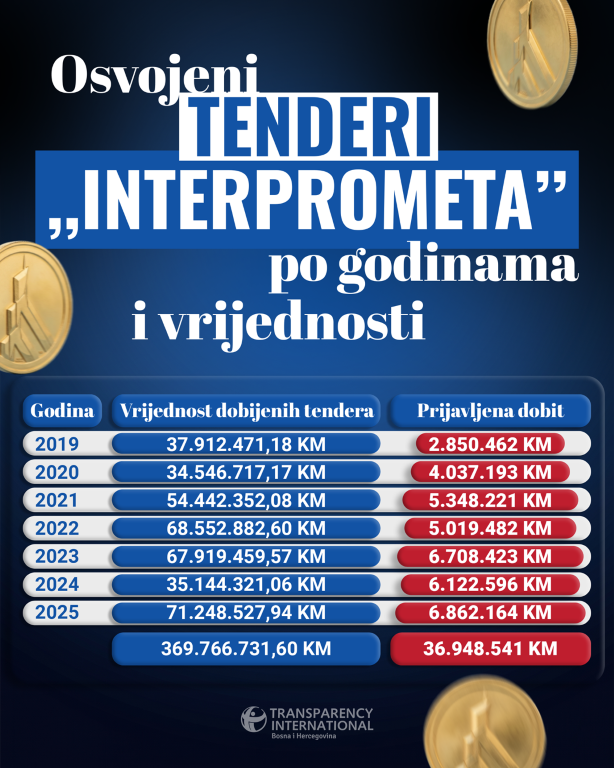
Their main partner is the Health Insurance Fund of Republika Srpska, to which they have delivered goods worth 330 million marks over seven years, including 65 million in the past year alone. This cooperation brought the owner of “Interpromet,” Dragan Pilipović, a record profit of 6.9 million marks in 2025 and the highest revenue since the company’s founding, amounting to 172.8 million marks.
The company “Integral Inženjering” from Laktaši ranks fifth by total tender value for the period 2019–2025. The value of their contracts with public enterprises amounts to 292.5 million marks, and they are primarily contracted with the aforementioned “Highways of Republika Srpska.” They were awarded the largest tender in March 2022 for the design and construction of the Bijeljina – Rača highway section, valued at 258.2 million KM.
Sarajevo-based “Hifa Petrol” has been awarded contracts worth over 290 million KM from state-owned enterprises by the end of 2025. Their main partner is the “Banovići” Brown Coal Mines, to which they have delivered fuel worth over 60 million marks. They are also a significant supplier to the “Đurđevik” Brown Coal Mine, with a total value of contracted work amounting to 22.3 million KM.
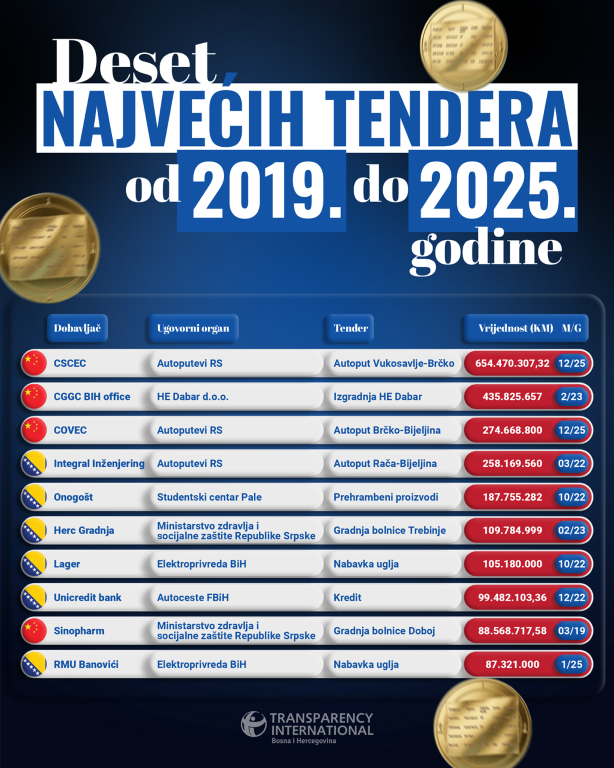
The company “Lager” from Posušje also bases a significant portion of its business with the state, specifically with the Electric Utility of Bosnia and Herzegovina. Over seven years, they have concluded contracts worth 265.6 million marks, the largest of which was in 2022 when it was agreed to deliver 600,000 tons of brown coal for the thermal power plants in Tuzla and Kakanj. From that contract alone, they earned 105.2 million marks.
Who distributes the most public funds?
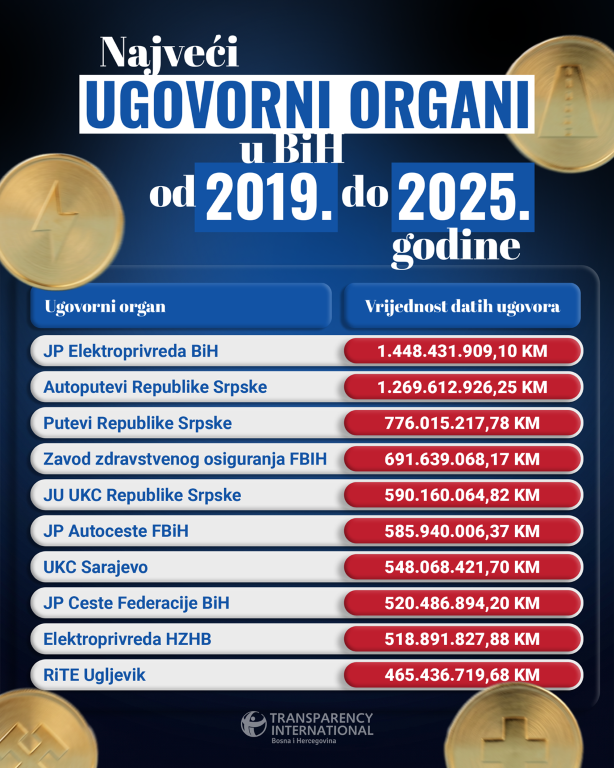
Overall, the largest contracting authority in BiH is “Electric Utility BiH,” which has awarded tenders worth approximately 1.5 billion marks since 2019. They are followed by “Highways of RS” with tenders worth 1.3 billion KM, while the Health Insurance Fund of Republika Srpska ranks third with public procurement valued at nearly 900 million KM.
Notably, what is interesting, as shown by the Integrity Watch BiH database, is that 77.1 percent of tenders were contracted through direct agreements, which is the least transparent legal procedure. The number of procedures is growing year by year, and in 2025 there were a record 205,534. For comparison, 142,911 tenders were conducted in 2019.
This is only part of the data available to the public on the Integrity Watch BiH website. It records companies that receive public tenders, contract values and procedures, tenders awarded to companies connected with public officials, and other risk indicators in public spending.
What distinguishes the Integrity Watch BiH platform is its exceptional interactivity and ease of use, which enables citizens and investigative journalists to “expose” public spending in just a few clicks.
Through visually clear charts, advanced filters, and searchable databases, users can cross-reference data on contracting authorities, the most successful companies, and types of procedures in real time.