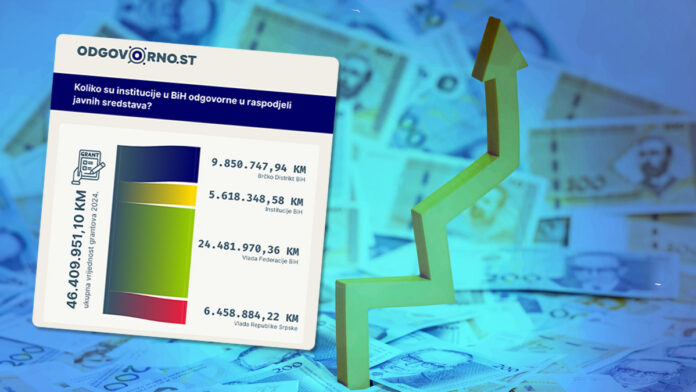
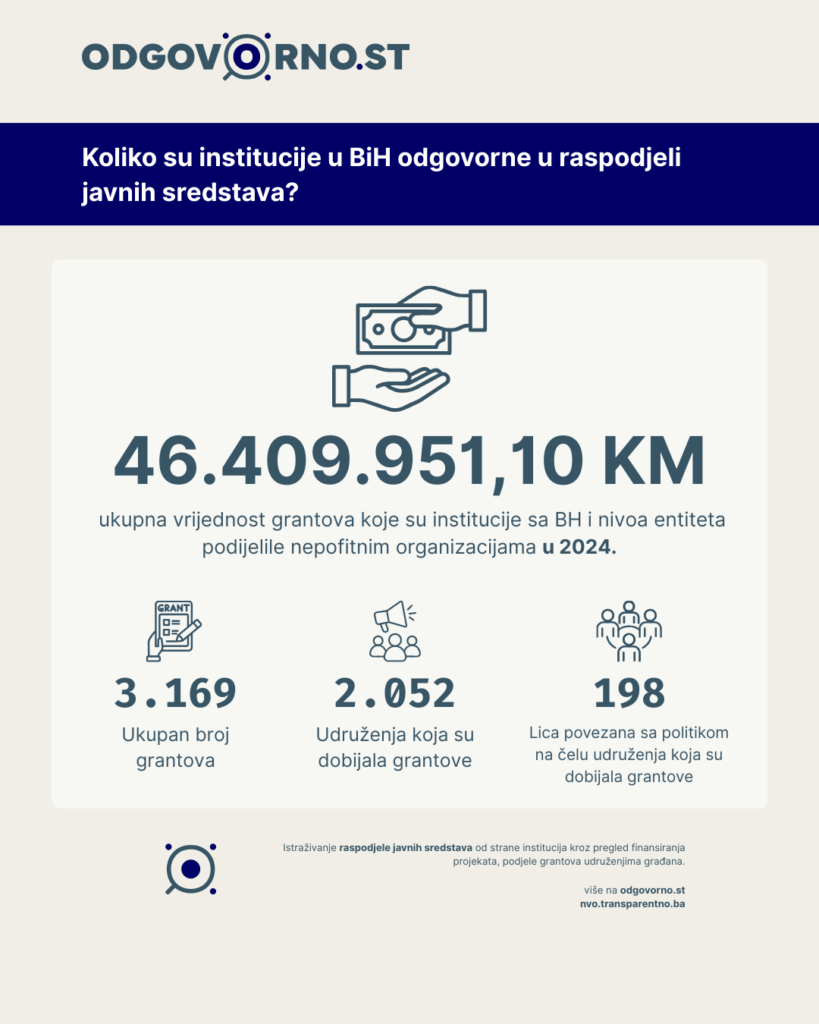
From the state and entity levels of government in Bosnia and Herzegovina during 2024, approximately 3,100 grants were distributed to 2,052 non-governmental organizations with a total value of 46 million marks. This is shown by data from Transparency International in BiH published on the Odgovorno.st platform, which measures the transparency and accountability of public institutions.
In numerous cases, funds were distributed without a public call and clearly defined criteria, as audit institutions have clearly emphasized, and public money was often distributed to organizations connected to politics.
This is sufficiently illustrated by the fact that 198 individuals who were on candidate lists are at the head of non-governmental organizations that received public money.
In some cases, these are public officials who, by managing associations financed with public funds, directly violate existing conflict of interest laws. It is particularly problematic that certain NGOs receiving public funds have directly engaged in political activities and election campaigns, which is clearly prohibited by law.
Funds distributed from the state level without a public call
According to data provided to Transparency International in BiH by institutions, approximately 5.5 million BAM was distributed from the state level in 2024, and traditionally the largest portion is distributed by the Ministry of Civil Affairs of BiH. The Audit Office has been pointing out for years that these funds are distributed to sports, cultural, and other associations without a publicly announced call, so it cannot be determined by what criteria public money is distributed. Auditors state that transparency was not ensured during the allocation of funds, and the justification and control of expenditure were not fully defined or implemented in an adequate manner.
Indicators from the odgovorno.st platform, which encompass joint research by Transparency International in BiH, the “Zašto Ne” association, and the Balkan Investigative Reporting Network (BIRN), show that the transparency and data openness index of this ministry has been continuously decreasing over the past four years.
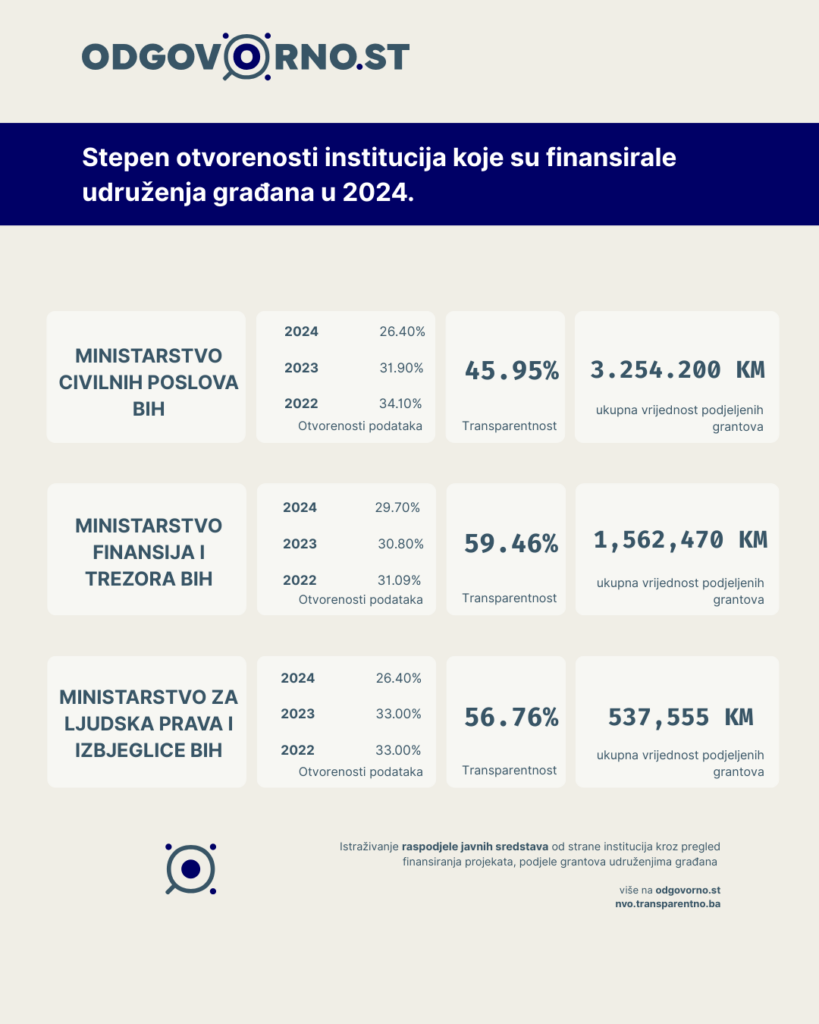
Money was also distributed by the Ministry of Human Rights and Refugees of BiH, and the head of the Citizens’ Association “Ostanak i ekonomski razvoj” Gornja Grapska, which received 50,000 BAM, is according to media reports related to Minister Sevlid Hurtić. Also, for several years now, the association “13. Rujan Jajce” has been receiving money from the state level, which, in addition to funds from the Council of Ministers, also received money from the budget reserve by decision of the Deputy Chairman of the House of Peoples, Dragan Čović. A member of the presidency of this association is Ivo Šimunović, who is also an HDZ delegate in the House of Peoples of the FBiH Parliament.
TI BiH has already published numerous examples of conflicts of interest, as public officials are prohibited from managing associations financed with public money, but poor laws and arbitrary application leave room for such occurrences.
The problem of corruption and political influence in the allocation of public funds to citizens’ associations has been recognized in the anti-corruption strategy of BiH, but the low level of transparency at the highest state level of government, as shown by data from the Odgovorno.st platform, is a clear sign that domestic authorities have not taken any serious steps to reduce corruption risks, comply with audit recommendations, and make the process of distributing public money more transparent.
In RS, the association that engaged in the election campaign received the most money
Transparency in the distribution of grants to non-governmental organizations is even lower at the entity level, where the data openness index is significantly decreasing in institutions that distribute the largest amount of funds.
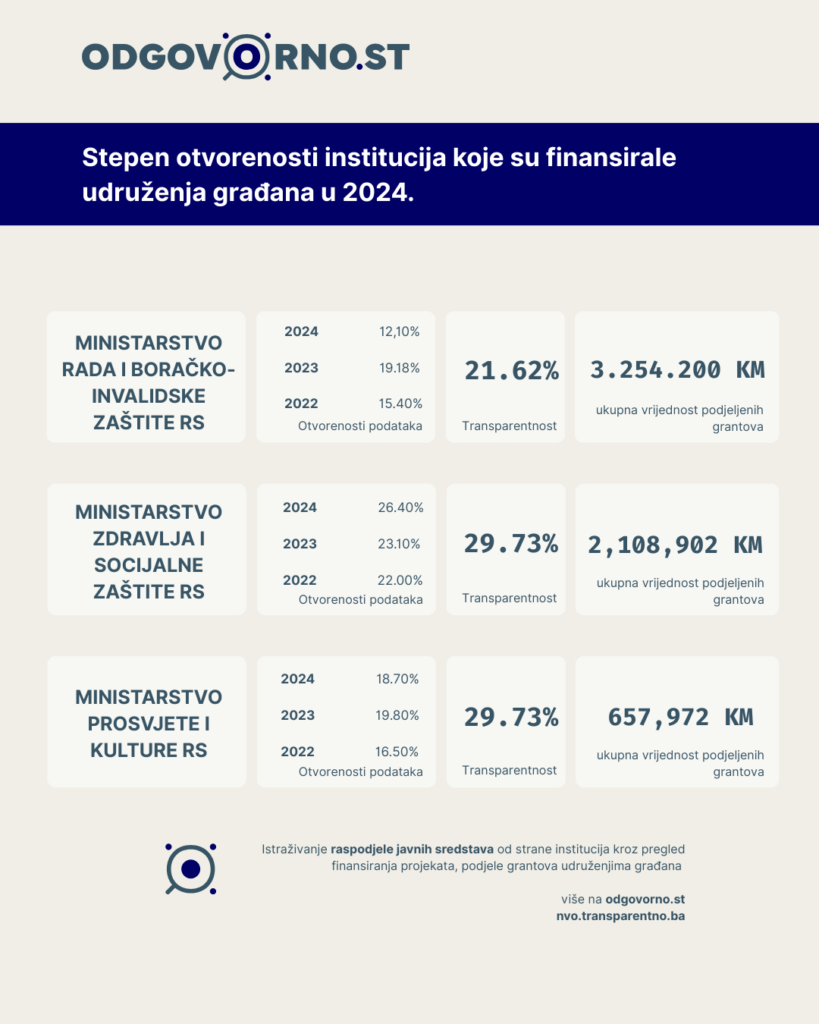
The Government of Republika Srpska, through several ministries, distributed approximately 6.4 million BAM according to data provided to TI BiH. The largest individual funding amount of all organizations was received by the Pensioners’ Association of Republika Srpska, totaling 710,000 BAM. The president of this association, Ratko Trifunović, came to this position from the position of president of the SNSD pensioners’ active group.
During the election campaign itself in the extraordinary elections for the President of Republika Srpska held at the end of last year, Trifunović called on pensioners to support the SNSD candidate Siniša Karan in the elections, although the Law on Associations and Foundations of RS clearly prohibits non-governmental organizations from engaging in the pre-election campaigns of parties and candidates.
This absurdity best illustrates the extent of political influence on organizations receiving public funds. The most money is distributed by the Ministry of Labor and War Veterans and Disabled Protection of RS, which, according to data from the Odgovorno.rs platform, is significantly reducing its data openness index. It should be noted that despite three court rulings, this ministry still has not provided TI BiH with data on the misuse of public money by veterans’ organizations that received funds in previous years and spent them, according to auditors’ assessments, “on salary payments and material costs, rather than on the implementation of program activities and specific projects.”
In FBiH, money is distributed without measurable criteria
From the level of the Federation of BiH, according to data provided to TI BiH, over 24 million BAM was distributed to non-profit organizations. In the audit of budget execution for that year, federal auditors warned that measurable criteria for evaluating projects for the purpose of objective scoring were not established, nor was
documentation defined that would confirm the fulfillment of criteria in the distribution of funds to non-governmental organizations.
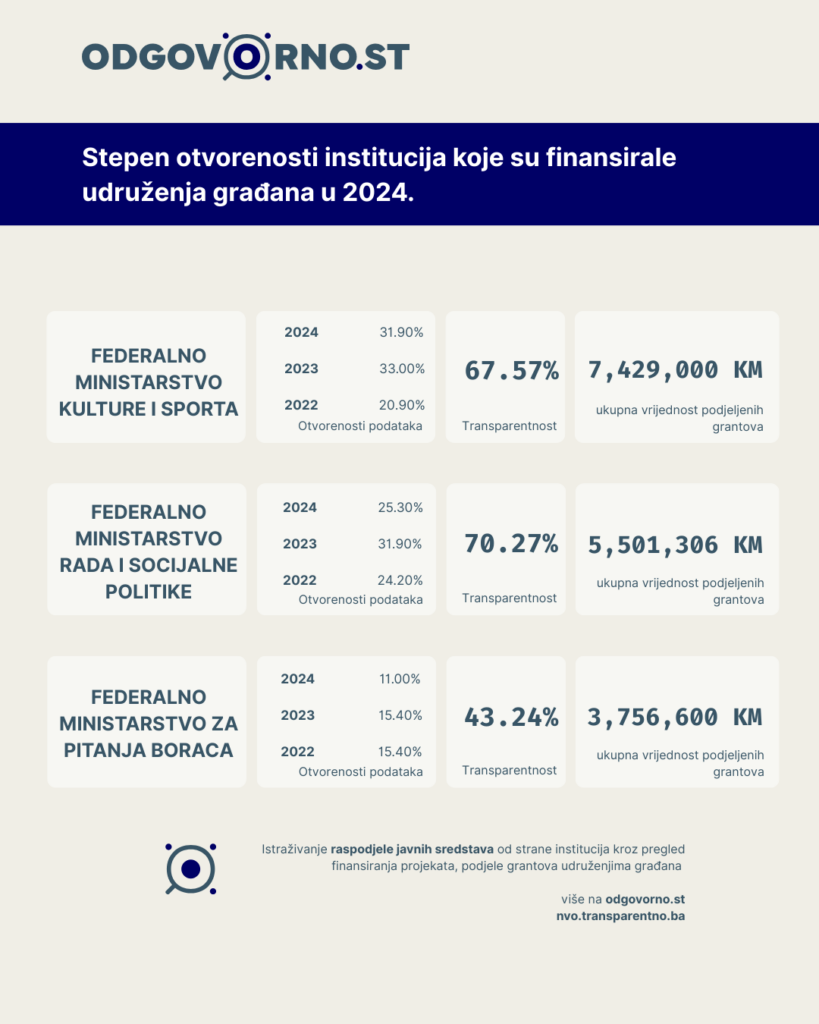
It is particularly problematic that additional funds for non-governmental organizations were distributed from the budget reserve without applying urgency criteria, where federal ministers, according to auditors’ findings, took greater authority than they had under the law. Research published on the odgovorno.st platform shows a significant drop in the transparency and data openness index of key institutions distributing these funds in FBiH, and any reduction in transparency opens additional space for corruption and abuse.
Compared to the budget size, by far the largest percentage to non-governmental organizations is distributed by the Brčko District authorities, which provided TI BiH with data on nearly 10 million BAM in grants allocated in 2024. It should be noted that the District has been shaken by numerous scandals regarding the distribution of this money in earlier periods. In the latest report for the mayor’s office, Brčko District auditors called for the establishment of a register of donations awarded by the Government and institutions of Brčko District BiH for more effective control, analysis, and planning of donation allocation.
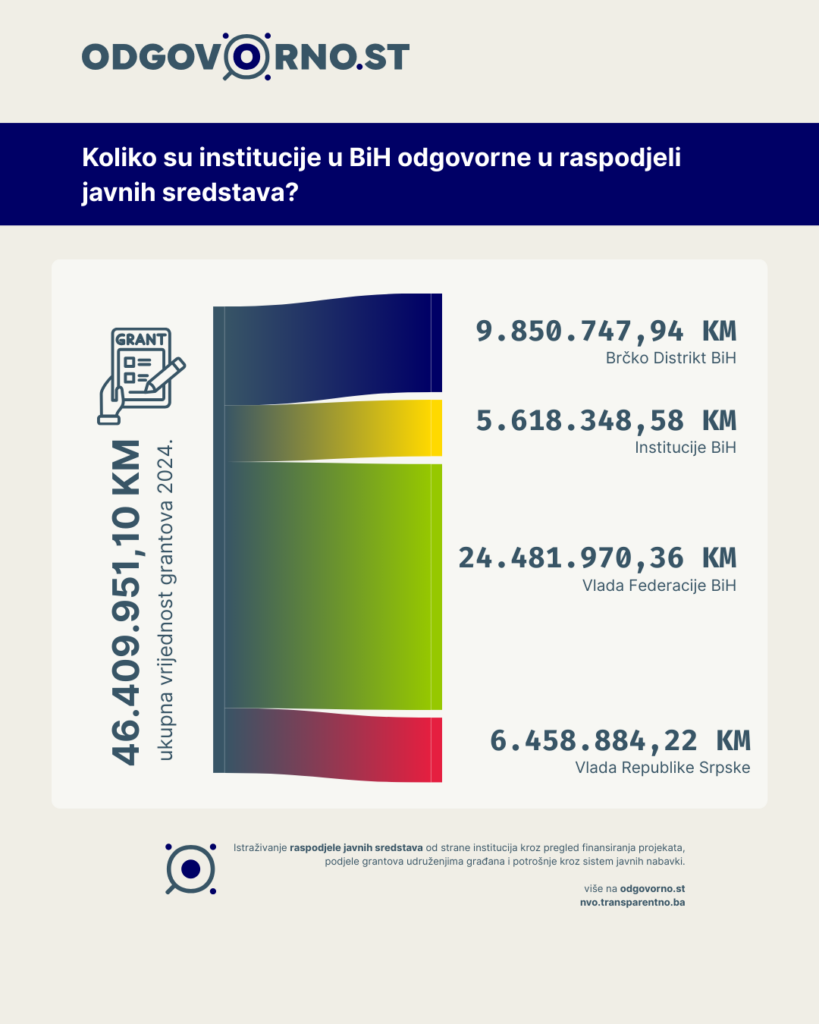
Since similar registers have not been established at higher levels of government that allocate significant funds, the data from TI BiH, BIRN, and the “Zašto NE” association, which are consolidated on the odgovorno.st platform, represent one of the few mechanisms that enable monitoring and control of grants awarded to non-governmental organizations in BiH.
The indices measured by the platform show a low level of transparency of institutions and a high degree of political control over the financing of the civil sector from the budget. Funds are distributed to associations that often do not even have a website, do not publish reports on their work, nor on the purposes for which they spend public funds, and examples of direct misuse of public funds for political purposes are increasingly common.