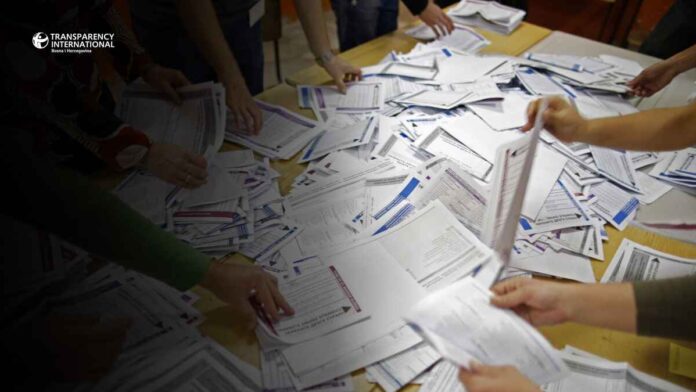
No one is guilty, but the Court proved that vote theft in the Doboj elections occurred using the same model at almost all polling stations – by adding votes for voters who did not turn out to vote or deceased persons who were not removed from the voter list.
Nearly five years after the annulment of the 2020 Local Elections in Doboj, trials for the largest case of electoral fraud handled by the domestic judiciary are still ongoing. 67 indictments were filed against 350 individuals, and the Basic Court in Doboj, according to the latest information, has issued 27 acquittals for 139 individuals and only one conditional sentence against two persons. Most verdicts were rendered following the same pattern: electoral fraud was proven, but there is no evidence that polling station committee members are guilty of it.
In 22 first-instance verdicts analyzed by Transparency International in BiH, it is confirmed that the Prosecutor’s Office in all cases managed to prove through material evidence and witness testimonies that the electoral will of citizens was most often altered according to two scenarios:
- Voting on behalf of voters who did not turn out to vote – most often those living abroad,
- Voting on behalf of deceased persons who were not removed from the voter list.
The trial was preceded by the annulment of the elections by the CEC, followed by criminal complaints, investigations, and indictments. Suspicion arose due to a record turnout of almost 70%, and at some polling stations, according to CEC calculations, it was determined that one voter voted every 50 seconds.
After recounting the votes, the CEC entered a procedure in which graphological examinations of voter signatures were conducted and compared with IDDEEA data, and it was determined that 10-20% of voter signatures were forged. Most often, according to this finding, it involves forging similar or identical signatures by one person for multiple entries under different names or adding initials in multiple entries.
What Was Proven in Court?
The Prosecutor’s Office, in most cases analyzed by TI BiH, proved the theft of one to seven votes per polling station, by presenting witnesses who confirmed that they or their close relatives did not turn out to vote and that their signatures were forged. The proof was complicated by the fact that a number of people whose votes were stolen had not come to BiH for years, the police could not find them at their addresses, and testimonies from neighbors that they rarely come could not be accepted as evidence that they did not vote. Similarly, Border Police data showing that these individuals did not enter BiH during that period could not be used as evidence in Court, as there is no obligation to record every border crossing.
Therefore, relevant evidence was mainly testimonies from voters who clearly confirmed that they did not turn out to vote. Also, evidence was accepted in cases where deceased persons voted and where it could be clearly confirmed that the death was reported before the elections were held. The Prosecutor’s Office, therefore, managed to prove this phenomenon in all verdicts, and one of them states:
From the presented evidence of the prosecution, testimonies of prosecution witnesses V. A., G. S. and D. G. who are explicit in testifying that they did not turn out to vote on the critical occasion, and by examining the Death Register Extract for persons V. J. and D. M., the Prosecutor’s Office has with the presented evidence proven that the mentioned 5 persons did not turn out to vote on the critical occasion and did not sign in the mentioned entries, but someone else did it, the verdict states.
Almost the same conclusion is repeated in most verdicts. In some cases, the Court rejected the proposal for graphological expertise to determine whether polling station committee members made the disputed signatures. In some cases, they did not agree to provide a handwriting sample, and it was considered that this would not prove the act they were charged with.
Who is Guilty?
Due to all this, the competent court considered that the prosecution did not prove that polling station committee members were guilty because someone signed on behalf of voters who did not turn out to vote, and everything was, among other things, justified by the fact that the elections were held during the pandemic and that wearing masks made it difficult to identify voters.
In most verdicts, the Court states that the established fact that there was falsification of election results cannot automatically mean criminal responsibility of election administration members.
The Prosecution did not prove which polling station committee member determined the identity in that case, who allowed that person to sign, and who handed over the ballots, nor to which candidate the mentioned vote went, because no evidence was presented on this circumstance, which was the obligation of the Prosecution, all this in conditions where voters must wear protective masks that cover most of the face, keeping distance, due to the mentioned Covid rules, states one of the verdicts.
The Court considered that it is quite possible that “another person with similar characteristics to those who did not vote appears and votes on their behalf, without the polling station committee members knowing about it at all, let alone as the Prosecutor’s Office states that they all enabled it together and simultaneously and wanted it”. Also, according to the Court’s statements, the fact that the election result was changed remains unproven, given that it is “impossible to determine which candidate the mentioned votes went to”.
What Were the Observers Doing?
The Court further argues the verdicts with statements from some witnesses who were observers on election day, as well as the fact that at numerous places none of the observers from different parties had objections to the electoral process. The fact that a large number of observers were not allowed to enter the polling stations was not subject to proof, and an additional argument is that the polling station committee members themselves were proposed from “opposing political options”.
Thus, in one of the verdicts, it is stated as an argument in favor of the accused that “five polling station committee members who found themselves there on behalf of completely different political subjects, namely P. B. on behalf of SDA-SBIH-HB, B. R. on behalf of HDZ BIH, B. B. on behalf of SPS, K. M. on behalf of GOJKOVIĆ NENAD-independent candidate, K. B. on behalf of SEKULIĆ SLAVKO-independent candidate, i.e., on behalf of politically opposed options”.
However, these conclusions completely ignore the absurdity that the majority of observers and polling station committee members were representatives of options that did not receive a single vote. Namely, 85 subjects registered for the elections, and 66 of them had fewer than 10 votes, and their intention was obviously to occupy positions in the polling station committees. Therefore, it is not clear from what the conclusion was drawn that
At one polling station, where it was proven that deceased persons voted, the SNSD observer “did not notice anything unusual”. At another, where it was proven that persons who were abroad voted, the observer from “Movement Most 21”, which had one vote in the entire Doboj, states that he did not notice irregularities, while in favor of the defense, an SNSD observer at the same place testifies, denying that “during the vote counting, any of the polling station committee members subsequently inserted ballots or added names”.
Voter List Problems
It is precisely this fact that the entire electoral fraud took place in front of the eyes of observers and polling station committee members, who nominally belonged to different political options, that raises numerous other questions and further undermines the integrity of the electoral process. From the statements themselves, it is evident that there were several possibilities – from those where the disputed votes were added after the count, to the fact that a large number of people went through the process of identity verification and voted in someone else’s name.
The CEC data on 10-20% of signatures that could be certainly determined to be forged illustrates the scale of electoral fraud, and who were the masterminds and organizers in these procedures was not even subject to proof. However, the verdicts confirm that the inaccuracy of the voter list is the main source of electoral irregularities, because in addition to inaccurate keeping of data from death registers, the fact that tens of thousands of people leave BiH every year, while simultaneously remaining registered to vote at a regular polling station, opens up additional space for abuse.
The verdicts themselves raise other questions, such as whether the persons in charge of organizing electoral fraud had access to institutional data before the Voter Register Center. These examples show the necessity of introducing electoral technologies, primarily for electronic voter identification through fingerprints, as well as scanners for vote counting to restore citizens’ trust in the electoral process.
In addition, it is crucial that the judiciary, in prosecuting criminal offenses related to electoral fraud, examines and demands accountability from the masterminds, i.e., persons involved in planning and organizing these acts, as the indictments so far have mainly been limited to polling station committee members, while party officials on whose behalf the frauds are carried out have never been prosecuted.