In February 2025, the Ivovik wind farm entered commercial operation as the largest facility of its kind in Bosnia and Herzegovina. However, behind this successful project lies a story of conflict of interest, legal uncertainty, favoring private interests, lack of transparency, and abuses that systematically undermine the public interest.
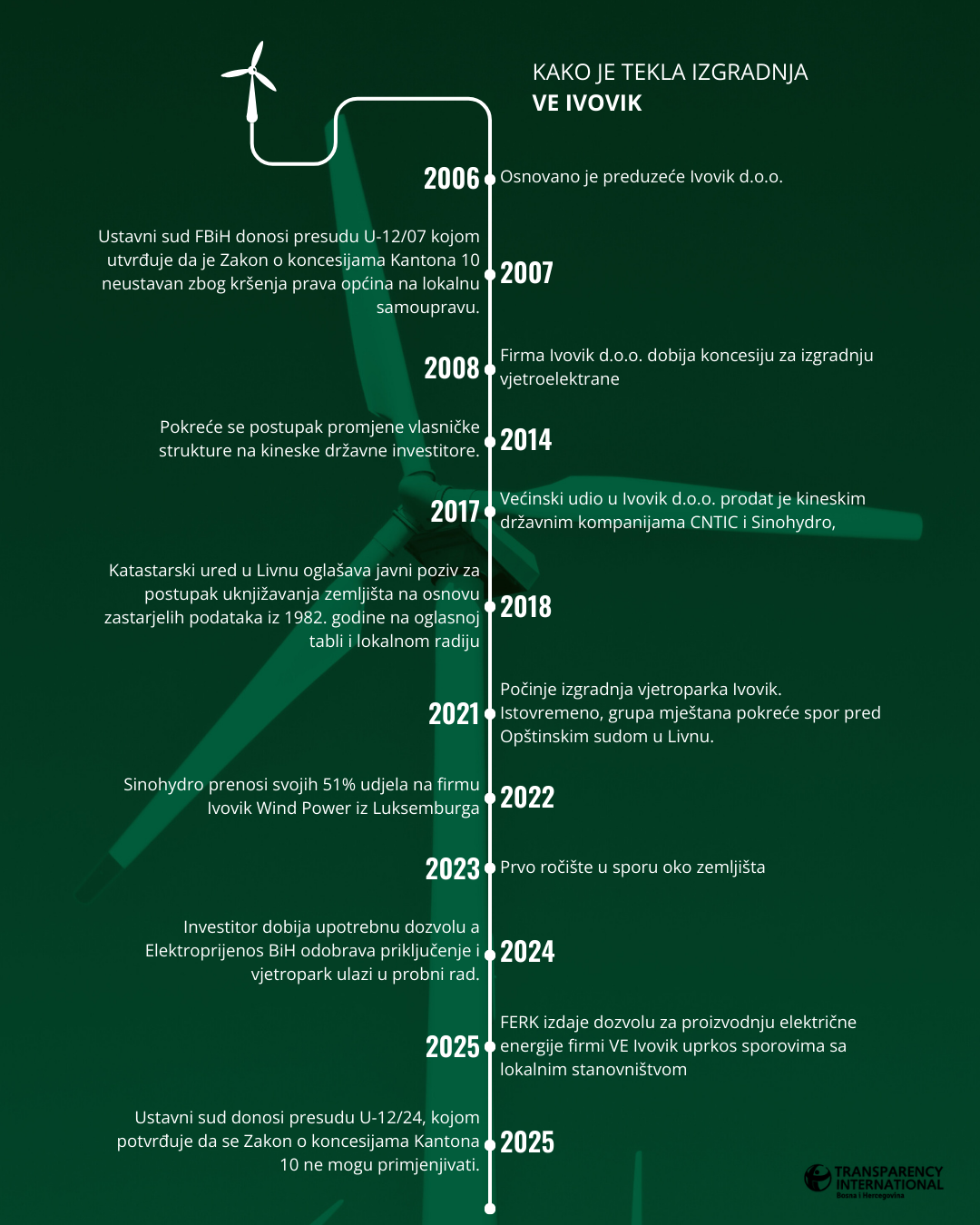
The Ivovik wind farm represents one of the largest investments in renewable energy sources in BiH, with a capacity of 84 MW and an annual production of 259 GWh of electricity. The construction of this facility began in 2021 on land that citizens claim was illegally taken from them, which is why a court case is still ongoing.
The cadastral office in Livno carried out the expropriation using a call for harmonization of outdated data from 1982, which was sent via local radio and the municipality’s notice board. As most residents of this area are displaced, in the diaspora, or do not regularly visit the local administration building, many missed the deadline for submitting proof of ownership and only learned at the beginning of the works that their land had been transferred to state ownership and that a wind power generation facility was being built on it.
A lawsuit was filed before the Municipal Court in Livno to prove that the land was illegally taken from private owners, but the competent institutions did not stop the project and continued to issue permits. Everything culminated with the permit from the Regulatory Commission for Energy in FBiH (FERK), after which electricity production was enabled even though the property dispute is still ongoing – which would automatically halt the project in countries with rule of law.
The problems surrounding the construction of the wind farm, which TI BiH detailed in its latest case study, extend back to 2008, when the Government of Canton 10 initially awarded the concession to the company Ivovik d.o.o. The owner, the late Ivan Matković, was the brother of Stjepan Matković, then Minister of Agriculture, Water Management and Forestry in the cantonal government. Apart from this potential conflict of interest, the concession award process for this project was carried out despite the decision of the Constitutional Court of the Federation of BiH that the Concessions Law of Canton 10 violated the right to local self-government and should not be applied, which this court reiterated in its 2024 decision.
Additionally, the Government signed the contract with Ivovik d.o.o., which is connected to a high-ranking official in that same government, for a period of 30 years with a fee of 20,000 euros and the condition that this period starts from the day of production commencement, not the signing of the contract. This favored the investor who was not obligated to implement the project immediately but was given the opportunity to wait for the right moment to resell the concession right, a practice known as “brokering” concessions.
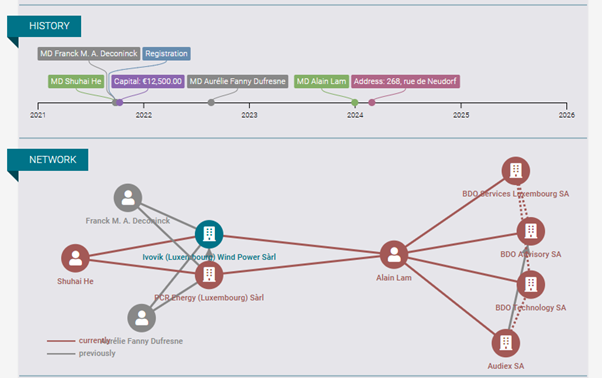
This eventually happened, and in 2017, Ivovik d.o.o. was sold to companies controlled by the Chinese government – CNTIC and Sinohydro for an amount of 8 million euros reported by the media, which was accompanied by the transfer of the concession right to build the wind farm. The ownership structure was later further obscured by transferring ownership to companies in Luxembourg, with the construction of the wind farm beginning in 2021.
By obtaining the use permit and approval for grid connection issued by Elektroprenos BiH, the facility began trial operation at the end of 2024, and in February 2025, FERK issued a permit for electricity production, allowing VE Ivovik to start commercial operation.
From that date, the concession fee of about 1.5% of the revenue from electricity sales, defined by the 2008 contract, also begins to be calculated – 17 years after the concession was granted and after the original owner had
Ivovik sends a mixed picture of a seemingly successful energy transition project, behind which lies a whole series of irregularities. The concession terms are written to favor the concessionaire, not the public interest, while the authorities have failed at every step: from awarding the contract, through supervision, to the final issuance of permits. Additionally, the entire process, which proved to be non-transparent, took place under the auspices of a law that is unconstitutional while the basic rights of citizens, such as property rights, were violated by the very institutions charged with protecting them.
This case illustrates the complete breakdown in the management of concessions in BiH, which are often used as an instrument for private gain at the expense of public interest, as pointed out by the first Concessions Registry in BiH published by TI BiH.
Legal uncertainty, lack of transparency, abuses, and favoring private interests are all characteristics of the concession granting process in BiH, which is why TI BiH calls for an urgent reform of the legislative and institutional framework – so that public resources finally serve the public, not private interests.