
If you randomly selected 10 managers of public enterprises managing forests in Bosnia and Herzegovina, you would find political connections in at least 9 of them. The situation is particularly pronounced in the Republic of Srpska, where out of 27 forest management leaders, 23 are party members. Adding the director of “Forests RS,” who simultaneously holds a position in the Mrkonjić Grad Municipal Assembly, we arrive at a disheartening fact: almost every decision regarding forest resources in RS has a political background.
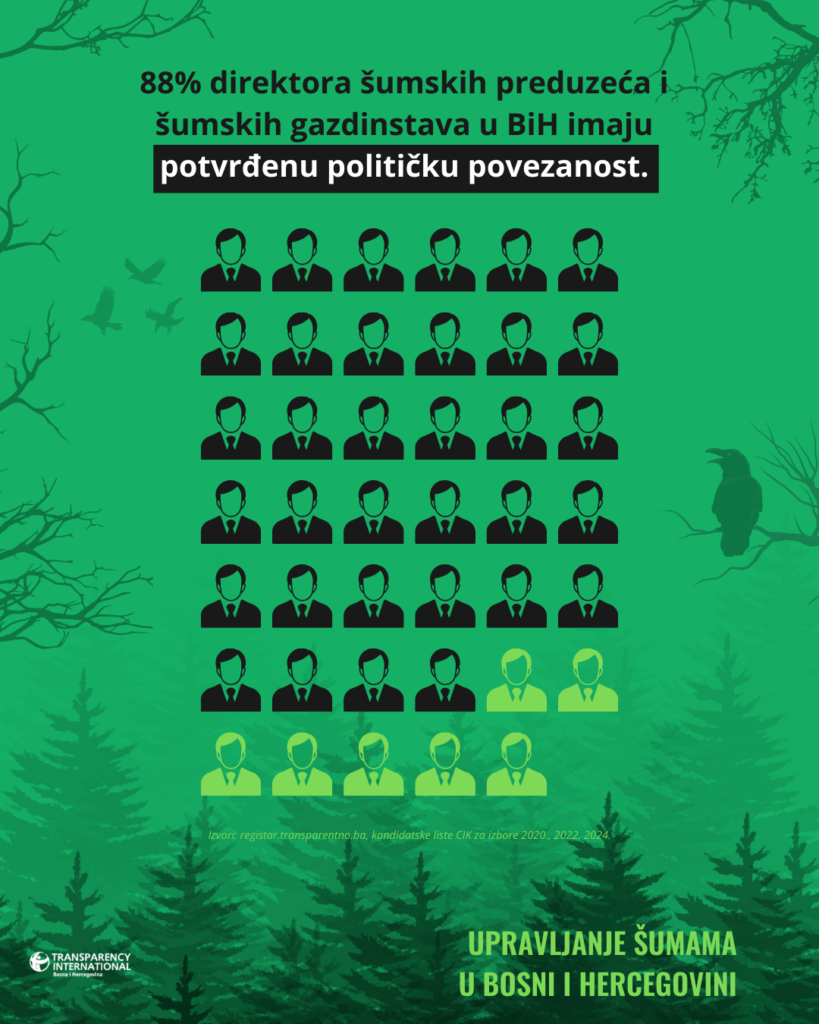
Based on data available in the Register of Officials, candidate lists for the 2020, 2022, and 2024 elections certified by the CEC, and media reports, it is possible to unequivocally determine the political background for 67 out of 93 individuals (73%) who are members of the boards of some forest enterprises in Bosnia and Herzegovina. Particularly concerning is the fact that 88% of directors of forest enterprises and forest managements have confirmed political connections.
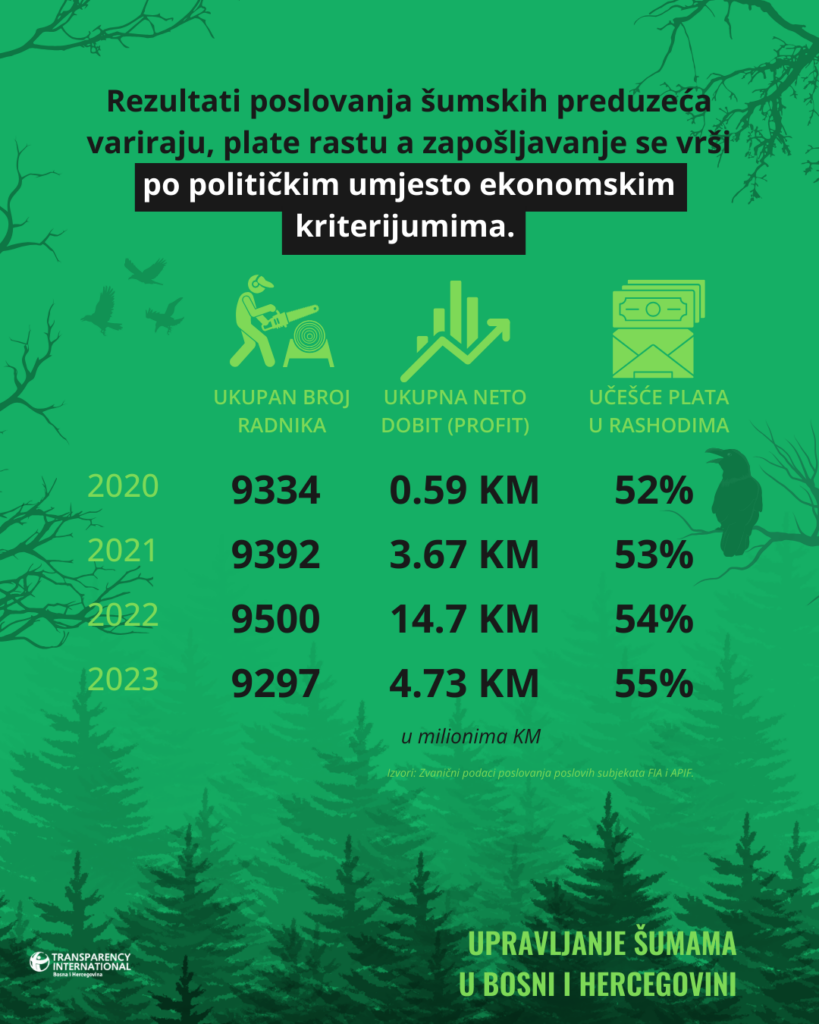
Thanks to operations under the patronage of politics, all forest enterprises in BiH achieved a profit of only 4.73 million marks in 2023, despite employing over
If the number of workers is considered in relation to the profit achieved, it turns out that each employee in forest enterprises in Bosnia and Herzegovina earned only slightly more than 500 KM annually, which shows the level of inefficiency prevailing in this vital sector. Given the political influence and laws that allow employment without competition and tolerate conflicts of interest, it is clear that these enterprises are becoming extensions of political parties, where resources are used for party employment instead of for the general social interest.
This statement is further confirmed by the continuous increase in salary costs, whose share in total expenses rose from 52% in 2020 to 55% in 2023, despite inefficient management and poor business results.
In addition to business problems, political influence also brings a lack of transparency, as seen in the example of the audit report of JP “Forests RS” from 2020, which the National Assembly of the Republic of Srpska considered only in March 2024, while business data from last year are still not available to the public.
Political influence further undermines the level of accountability in operations, best illustrated by data from the latest audit report of this public enterprise on uncollected receivables. Suppliers of forest assortments owe Forests RS over 17.5 million KM, while more than 10 million are considered disputed and questionable receivables, a significant amount of which is practically uncollectible because it relates to buyers of wood assortments who are bankrupt or have been dissolved.
A symbol of the lack of accountability under the patronage of politics is Strahinja Bašević, director of SG “Romanija” Sokolac, who was suspected of abuse of position in August 2024, then went into hiding and was arrested, but despite this, he won the Local Elections as the SNSD candidate for mayor of Sokolac. Although problems in forestry throughout Srpska have been discussed for years, changes only occurred after RS President Milorad Dodik publicly spoke about the massive theft in Forests RS at the end of 2024, yet Bašević still remained in the position of director of SG “Romanija” Sokolac.
A particular problem is that the forestry sector in a good part of BiH is unregulated because in the Federation of BiH, since 2009, there is no forest law, after it was annulled by the Constitutional Court of the Federation. In response, cantons have enacted their own laws, leading to further complications in operations and a kind of discrimination since the amounts of fees for forest use vary from canton to canton. Thus, some local communities achieve significantly higher revenues from forest cutting – as if the value of the forest depends on where it is cut, rather than its actual economic and ecological importance.
This is best illustrated in the Herzegovina-Neretva Canton, where there is also no forest law, so forest cutting and management occur without legal basis. Although three forest enterprises with about 190 workers annually cut 77 cubic meters of wood mass and achieve a revenue of 8.6 million KM in 2023, citizens in this canton feel little benefit from this activity.
Namely, precisely due to the absence of a law, all funds from fees for cutting and using forests are paid into the canton account, while not a single mark is paid into the budgets of municipalities and cities in HNK, unlike other areas in BiH where the method and relationship of distribution of these funds are regulated by law. Besides the lack of a legal framework, the operations of forest enterprises in this entity are marked by a lack of transparency, and the most drastic example is the gap of seven years between two audit reports of Forestry “Prenj” d.d. Konjic (
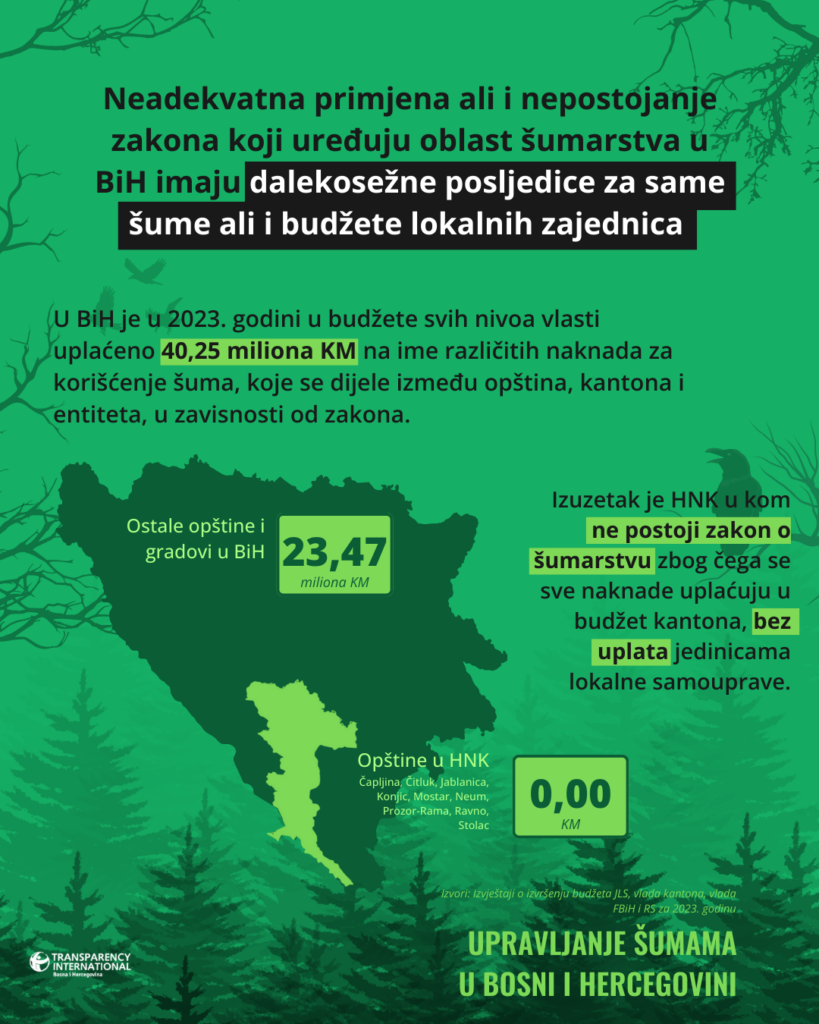
The distribution of forest fees is problematic in the rest of BiH as well, since approximately 40.2 million KM is paid annually into the budgets of entities, cantons, and local self-government units in the name of various forest use fees. However, the analysis showed that the distribution of these funds occurs without clear criteria and indiscriminately.
For example, the competent Ministry in RS distributed funds collected from forest fees without predefined conditions and criteria, and the audit found that activities were financed that have no direct connection to afforestation and forest works, such as scientific research, publishing, and the arrangement of private parcels.
Political influence, poor legal framework or, in some cases, their complete absence, and lack of transparency have created a culture of business irresponsibility that has led to poor business results, corruption and abuse. All this has allowed parties to use forests for their interests, which ultimately affects citizens through lower budget revenues while the greatest damage is suffered by the forests themselves, whose preservation and restoration are secondary.
Due to all this, it is necessary to take measures aimed at improving transparency, management, and sustainability of forests in Bosnia and Herzegovina, which includes:
• Immediate depoliticization of these enterprises,
• Enactment of laws in the Federation of BiH and HNK to regulate this area, and
• Harmonization and rationalization of forest use fees
• Establishment of a body to coordinate the work of forest enterprises in BiH, which would maintain a unified forest register for BiH with data on forest-economic bases, records of cutting and distribution, and plans for forest protection and restoration.
Read more:
- How public enterprises operate in BiH: Drastic revenue decline, rising salary costs, losses twice as large
- How Railways operate in RS and FBIH: Million-dollar losses, excess employees, suspicious procurements, and expensive consultancy contracts
- TI BIH published the concession register in BiH: Numerous concessionaires accumulate debts, authorities hide information and avoid reforms
- Auditors suspect reported coal quantities exported from RMU Banovići to Serbia by a company linked to SNS. TI BiH filed a report with the financial police