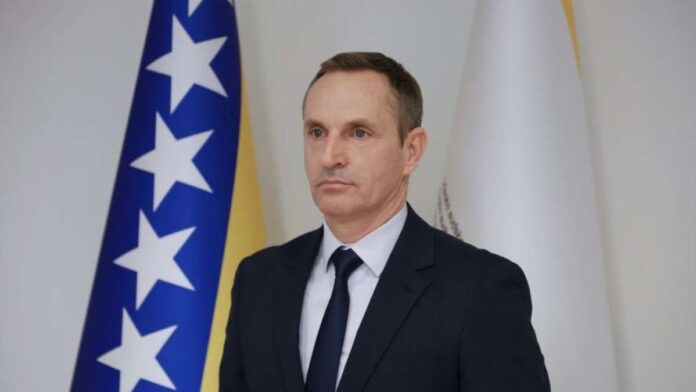
Ten years of waiting for the formation of the Special Department of the Federal Prosecutor’s Office of the Federation of BiH, better known as the “Federal USKOK”, has finally ended with the selection of Hrvoje Čabrajić as the head of this department, which will deal with prosecuting the most serious cases of corruption and organized crime in the Federation of BiH. However, instead of marking a turning point in the fight against corruption, this moment has raised numerous questions about political influence on the work of judicial institutions.
Amendments to the HJPC’s Rules of Procedure in October 2024 opened the door for Čabrajić’s candidacy, who according to previous rules did not meet the requirements and who was then selected as the third-ranked candidate for the head of the Department.
In addition, the process was accompanied by numerous controversies in the public, culminating in a heated discussion at the last session of the HJPC, where President Halil Lagumdžija made claims about the existence of “enemies of the Council” and information that could have stopped this appointment. Thus, the selection of the first person of one of the key institutions for fighting corruption has once again undermined the integrity of the BiH judiciary and raised numerous other questions.
How was the door opened to a candidacy that would not have been possible under previous rules?
The first competition for the head of the department was annulled at the session of the HJPC of BiH on September 26, 2024, with the explanation that most candidates did not have the required experience in cases of organized crime and corruption. The re-announcement of the competition was preceded by amendments to the Rules of Procedure of the HJPC of BiH, which changed the criteria that candidates must meet.
Specifically, one article[1] was amended to reduce the criteria for the minimum number of points required to propose candidates for appointment, and by amending another article [2], it was made possible for candidates who perform the function of deputy chief prosecutor not to have to spend five years in that function for their candidacy to be further considered, although this condition still applies to all other judges and prosecutors.
For example, a judge with 10 years of experience in a municipal court and 3 years in a cantonal court does not meet the criterion of minimum five years of experience at the cantonal level. On the other hand, deputy chief prosecutors are the only ones who, according to the new amendments, do not have to spend 5 years in that function for their application to be further considered.
This approach creates unequal rules and favors a specific group of candidates, and can certainly be linked to the appointment of Hrvoje Čabrajić as the head of the Federal USKOK. He had been the deputy chief cantonal prosecutor of the Sarajevo Canton Prosecutor’s Office since 2021, and had been in that position for about three years by the end of the competition procedure. These changes raise questions about the role of the HJPC in the process of adapting rules to the chosen candidate, and the lack of transparency in the process itself further fuels doubt.
What information could have influenced the appointments of judges and prosecutors?
The appointment of the head of the Federal USKOK was accompanied by media reports about political trading of this position and the position of director of the HJPC Secretariat. Referring to these writings, the President of the HJPC said at the session on January 15 this year that “enemies of the Council sit in this Council“.
Some of the HJPC members interpreted these statements by Halil Lagumdžija as a potential threat. Davor Martinović, a member of the Council, said he was disappointed with the allegations made and asked the president to clearly name the members he characterized as “enemies of the Council and the system”. He also called on the president to explain who he specifically meant when talking about the politicization of procedures and exerting influence.
“You will see that my statement about ‘enemies of the system’, when I tell you the facts – you won’t be able to escape that statement, don’t ask me for more information now. If I had started talking, it would certainly have led to the postponement of this, and the appointments – I am ready to bear the burden of what I have been inputted to do. When this is over, the public will learn all the relevant details,” Lagumdžija said at the session.
Everything happened during a public session of the HJPC, and Lagumdžija’s claim that the appointment would have been postponed if he had started talking in public further compromised the entire process. Because of all this, the question arises as to what information the HJPC president had that he did not disclose, and how this information could have influenced the outcome of the Council members’ vote.
In addition, the media allegations suggesting possible influence peddling have not been clarified, which may have negative consequences on citizens’ trust in the work of the judiciary. The process of appointing the head of the Federal USKOK itself was marked by significant procedural controversies that affected the final outcome. Because of all this, it should be emphasized again that stronger mechanisms of control and protection of integrity are needed when appointing to key positions in judicial institutions.
Unfortunately, these key issues regarding objectivity and transparency, and the integrity of the appointment process to judicial functions, have not been adequately addressed even in the new draft Law on HJPC that the Ministry of Justice has sent for public consultation.
Transparentno.ba
[1] 59a of the HJPC Rules of Procedure
[2] and Article 49 in connection with paragraph (5)[2] point b) – “For a candidate who is a deputy chief prosecutor, the continuous period of work in the position of holder of a judicial function in the prosecutor’s office where the candidate performs the function of deputy is included in the period referred to in paragraph (5) point b) of this Article.”