The recently published SIGMA Monitoring Report 2024 for Western Balkan countries provides a comprehensive overview of public administrations and reform achievements across all six reform areas defined by SIGMA in the Principles of Public Administration (Strategic Framework for Public Administration Reform; Policy Development and Coordination; Public Service and Human Resource Management; Organization, Accountability and Oversight; Public Services and Digitalization; Public Financial Management) according to an updated methodology based on previous experience.
Thirty-two principles across six thematic areas, 36 indicators, 289 sub-indicators, and 1,372 individual criteria outlined in the report methodology demonstrate the depth and comprehensiveness of this diagnostic assessment of public administration.
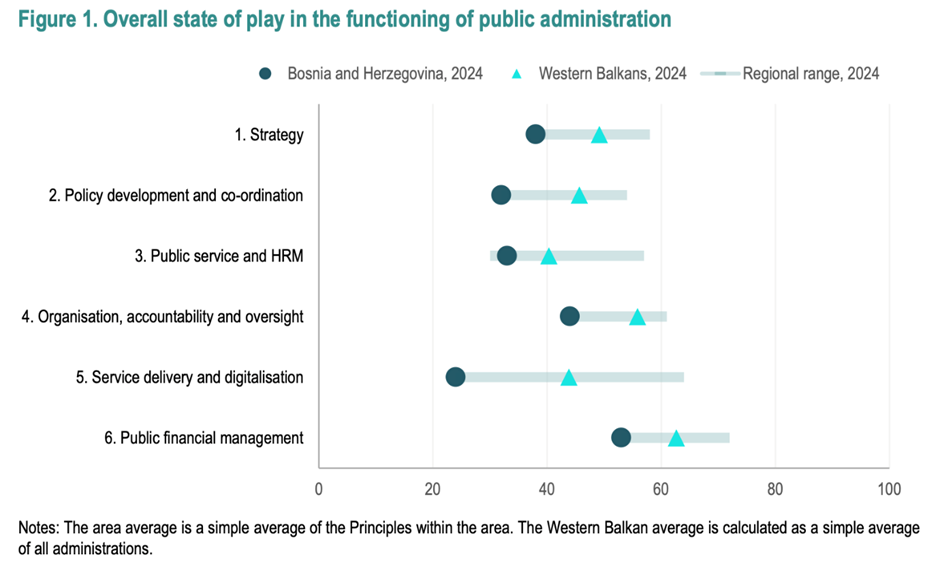
Even for those with a superficial understanding of public administration conditions, it comes as no surprise that Bosnia and Herzegovina scored far below the Western Balkan regional average in all thematic areas, ranking lowest in all but one area.
When we translate this situation from politically correct and characteristically cautious analytical language into terms everyone can understand, we can briefly state that public administration reform is not happening!
Just over a year ago, TI BiH organized a conference in Sarajevo marking two decades since the beginning of public administration reform in BiH, titled (un)learned lessons. The general conclusion was that we are still at the very beginning of reform – here and there a law is adopted, a bylaw is passed, training is held, but no substantial progress in reforming public administration has occurred. In short, there is no political will, and consequently, no capacity for serious reform.
Regarding the strategic framework for public administration reform, according to SIGMA report findings, despite political proclamation of reform as a key priority, the implementation level of the 2020-2022 strategy is only 5%. This figure speaks for itself and hardly needs further comment.
In policy development and coordination, no progress has been recorded. This effectively means that the policy-making process is non-transparent, non-inclusive, and not based on indicators and analysis, resulting in an devastatingly low quality of policies and laws.
The situation in human resource management is certainly no better; formally prescribed criteria for merit, monitoring, and evaluation of civil servants’ work are merely dead letters on paper. In practice, this means that public trust in civil service is only 29%, far below the regional average of 41%.
Similarly, there has been no progress in organization, accountability, and integrity. The Kafkaesque structured administration has long been an end in itself. If half the institutions were miraculously abolished, probably no one would notice except those employed there. Regarding transparency, there has even been a step backward with the adoption of the new Law on Access to Information at the state level, which provides worse and more rigid solutions than its predecessor. Integrity and accountability mechanisms, though formally prescribed, are practically non-existent.
The dramatic lag in reforms in public services and digitalization is most visible to citizens, as they experience it daily. The ridiculously low level of services, mostly provided through channels and methods established in the last century, remains the reality for BiH citizens and is a tragic testimony to administrative incompetence.
Public financial management also faces numerous challenges. Starting from problems with planning, execution, and oversight of budgets, through formally established internal controls, internal and external audits that practically fail to serve their intended purpose, to the notoriously problematic public procurement and concessions where irregularities occur daily.
Overall, public administration falls far short of its role as a public service aimed primarily at providing quality services to citizens; instead, public administration is a key lever for maintaining the ruling oligarchy. At the macro level, the public administration’s operation through clientelistic employment of party loyalists and cronyistic public procurement contracts awarded to privileged oligarchy serves as an anchor point for achieving the particular interests of the ruling minority – maintaining power and unlimited enrichment.
At the mezzo level of individual institutions, politically appointed officials have unlimited power over their institution, putting it in service of their own enrichment and securing votes for their political party.
While at the micro level, an individual has a very simple choice: if they want to be part of such a system, or public administration, they must comply with the rules of the game and first join a political party to even consider employment in the public sector.
If we have learned anything in these two decades of public administration reform, it’s that reforms are not just legislative processes, i.e., passing and/or amending laws. This is certainly an important part of the reform process but is just the tip of the iceberg, as we should have learned that a law that isn’t implemented is worth no more than the paper it’s printed on. The chasm that in our case exists between the normative and the actual, between what is prescribed by law and what happens in practice, is the best and most obvious testimony to how complex social processes reforms are.
Of course, there are no simple solutions for deeply rooted social problems, except in the imaginings of colorful populists, of which we unfortunately have no shortage. Another important thing we should have learned in these two decades of public administration is that context is extremely important, and it’s not enough to copy a Swedish law and expect that the situation in that particular area will be regulated in practice as it is in Sweden. Therefore, starting from our context of a completely captured state and hybrid regime, we need to seek solutions and sequence them according to context, keeping in mind that it is in the interest of the most powerful for nothing to change – because the existing situation is the best possible for them.
This means that the sequence of reform interventions should proceed in a way that doesn’t create resistance and blockage from the most powerful at the very beginning. An incremental, carefully designed sequence of reform interventions could therefore prioritize digitalization as a horizontal and vertical process across all thematic areas from the SIGMA principles. This should, on one hand, lead to increased quality of public services, which would in the next step lead to increased satisfaction of service users-citizens, and consequently lead to increased expectations from these same citizens towards the administration as a good prerequisite for next reform steps in terms of articulating citizens’ demands and creating pressure on the authorities. It would simultaneously be a generator of learning processes for civil servants who would have to adapt to a new environment and way of working – digital.
For starters, if it’s not too ambitious, it would be good if decision-makers at least read this Monitoring Report. And it would be ideal if the findings and recommendations were discussed.