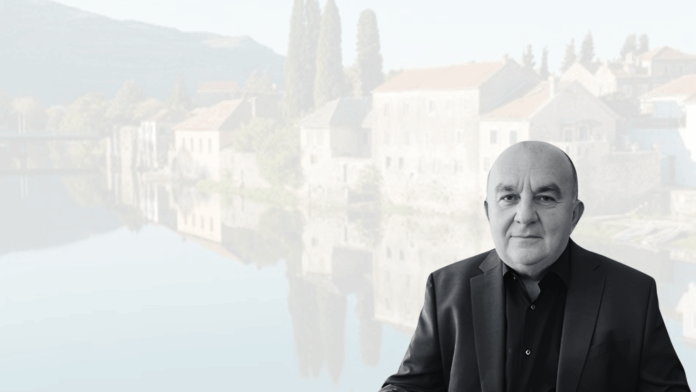
Ranko Bošnjak, a councilor in the Assembly of the City of Trebinje and former director of the company “Monting-energetika” LLC, avoided responsibility for conflict of interest by leaving the director position after the Commission for Preventing Conflict of Interest of Republika Srpska initiated proceedings. Although “Monting-energetika” signed procurement contracts with the city of Trebinje worth over 1.6 million KM, which were executed while Bošnjak was both a councilor and director of the mentioned company, the Commission determined there was no responsibility, ignoring key facts and allowing avoidance of legal consequences.
Transparency International in BiH initiated proceedings to determine conflict of interest against Ranko Bošnjak, then a councilor in the Assembly of the City of Trebinje, director and owner of the company “Monting-energetika” LLC, which, according to available data, signed contracts with the City of Trebinje in 2022 with a total value exceeding 1.6 million KM. Such business dealings violate the Law on Preventing Conflict of Interest, which stipulates that companies of public officials may sign contracts with public bodies with a total value of 30 thousand marks in one year, while anything above that is considered a conflict of interest.
The Commission for Preventing Conflict of Interest in the authorities of Republika Srpska initiated proceedings against Bošnjak on August 3, 2023, and requested his statement, which he ignored. The Commission attempted again on October 17 to obtain a response on whether the allegations of holding incompatible functions were true. A response was received only on October 1, 2023, in which Bošnjak submitted evidence that on October 27, after the proceedings were initiated, there was a change in the leadership of the company “Monting-energetika,” which the Commission accepted and determined that there is no conflict of interest since Bošnjak is no longer the director of the company that conducted business with the state exceeding the legal limit.
Although a conflict of interest undoubtedly existed at the time the disputed procurements were executed, the Commission decided to accept the fact that Bošnjak is no longer in the director position, ignoring that the contracts were signed while he was simultaneously a councilor and director of the company, which, despite the change in the responsible person, remains in his ownership. In this way, the Commission allowed room for formal changes to leave space for the elected official to avoid sanctions for holding undoubtedly incompatible functions.
An additional problem in this case is the fact that Bošnjak also received an urgency, suggesting that he did not respond in time to the call for a statement, indicating a lenient attitude of the Commission, which, instead of immediately determining responsibility based on existing evidence, tolerated procrastination and allowed additional time needed for changes in the leadership of the company.
Moreover, even if the Commission had determined the existence of a conflict of interest and imposed sanctions, the legally prescribed fines of 500 to 1500 convertible marks are nothing more than symbolic sanctions compared to the 1.6 million KM with which the company owned by the public official conducted business with the body in which he has decision-making rights.
This case shows how conflict of interest in Republika Srpska is treated as a formality and that laws are applied selectively, depending on political and other interests, while the essential suppression of conflict of interest and accountability are avoided, either due to inadequate laws or institutions that do not enforce them.
We remind that the fight against conflict of interest is one of the 14 key priorities that Bosnia and Herzegovina must fulfill to obtain candidate status for negotiations on EU membership, while such examples not only undermine citizens’ trust in institutions but also seriously threaten the country’s progress towards European integration.