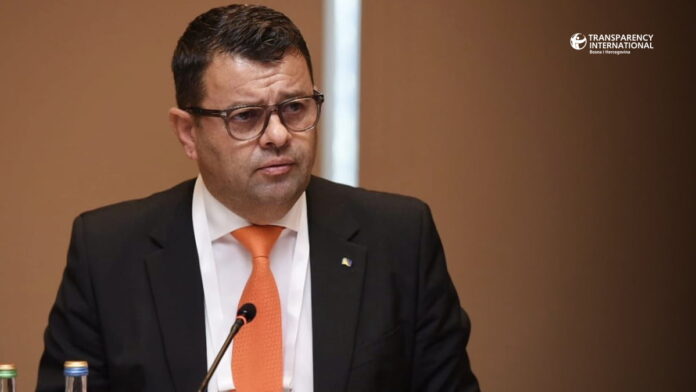
Publishing house “NAM” from Tuzla, owned by the current Minister of Human Rights and Refugees of BiH Sevlid Hurtić, recently received over 1.4 million marks from two tenders, although private companies of state officials are explicitly prohibited from entering into contracts worth more than 5,000 BAM with any body financed from the budget.
The Ministry of Education and Science of Tuzla Canton procured textbooks by a group of authors worth 990,996 BAM from Hurtić’s publishing house in September. Then, a few days ago, the Ministry of Education, Science, Culture and Sports of Una-Sana Canton awarded this publishing house a contract worth 435,119 BAM, and in both cases Minister Hurtić’s company was the only bidder.
What is problematic, however, is that the Law on Conflict of Interest in BiH Government Institutions clearly stipulates that ministers and other officials cannot be part of the management of any private enterprise that enters into contracts or otherwise conducts business with institutions financed from the budget at any level. Given that this is an obvious violation of the law, Transparency International in BiH has submitted a report to the BiH Commission for Deciding on Conflict of Interest. It should be noted that the work of this commission has been blocked on several occasions due to political obstructions, and the last session was not held due to lack of quorum. It is interesting that draft decisions on sanctions against Nermin Nikšić and RAK director Draško Milinović were on the agenda at that time, which TI BiH also reported for conflict of interest.
The private publishing house NAM, according to publicly available data, is owned by Minister Hurtić, who is also listed as a member of the management, and its value according to Hurtić’s asset declaration is estimated at 10 million marks.
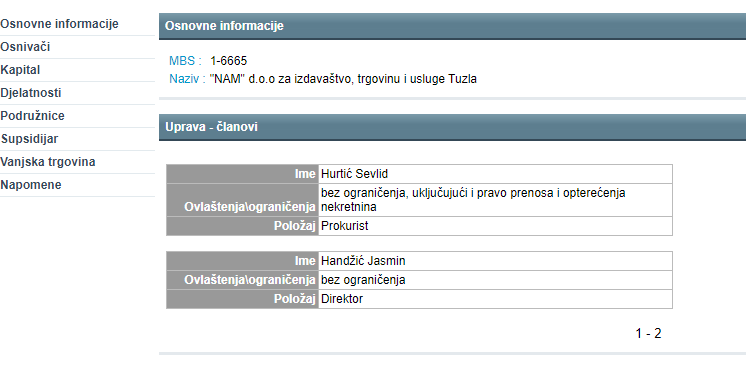
The total revenues of this enterprise, according to publicly available data, amounted to 2.1 million BAM by 2021, and increased to 4.1 million BAM in 2022, with a large portion of these revenues relating to business with public institutions.