Transparency International in BiH filed a complaint with the Financial Police of the Federation of BiH after the Audit Office of FBiH institutions questioned the reported quantities of coal that RMU Banovići exported to Serbia as well as the official claims of the former management of this public enterprise that it was coal of lower calorific value, which was therefore sold at lower prices. The majority of the disputed export from RMU Banovići went through the company “Lider – Pro” d.o.o. Sremska Mitrovica which is linked to the top authorities in Serbia. According to data from the Anti-Corruption Agency of Serbia, this company financed the Serbian Progressive Party campaign in 2017 with three million dinars (approximately 25,000 euros).
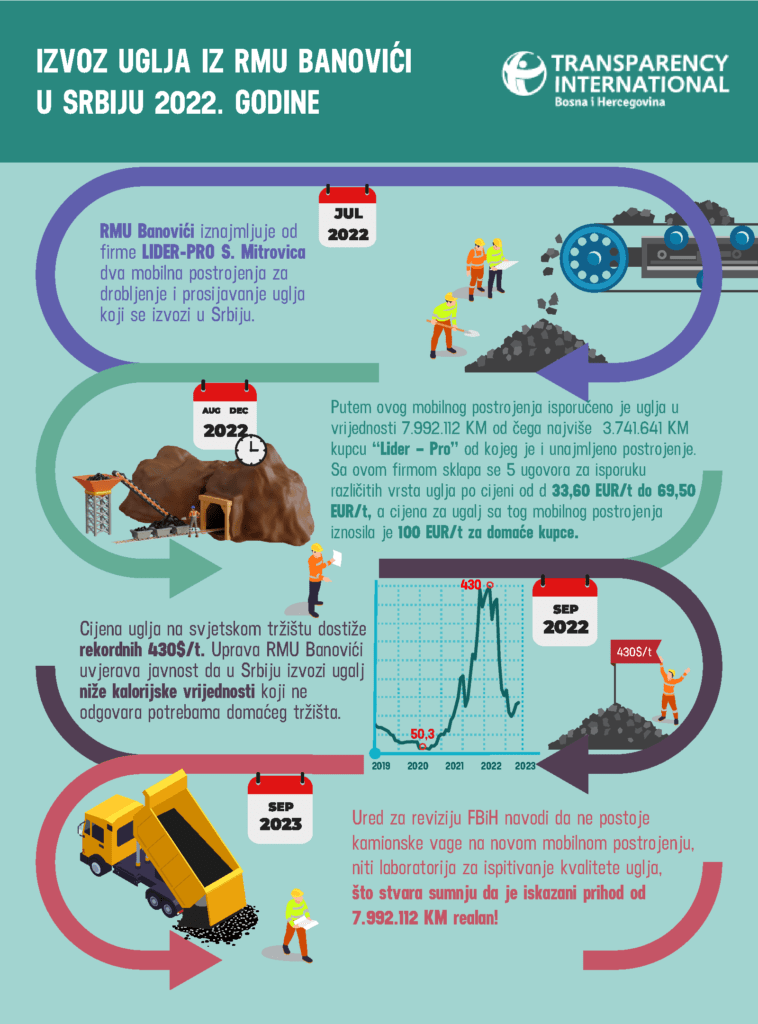
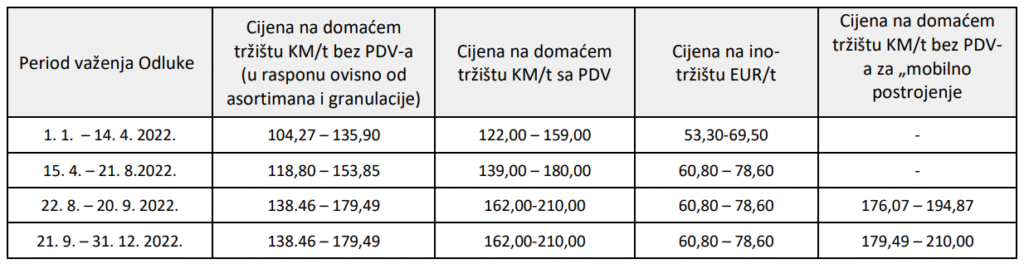
The mine management had previously rented two mobile coal crushing and screening plants from this company by concluding two direct agreements, without tendering. Then, according to the audit report, from August to December 2022, 39,382 tons of “dry screened” coal with a total value of 7,992,112 KM were delivered through this mobile plant, of which the largest amount (3,741,641 KM) related to the buyer “Lider – Pro” d.o.o. from whom the equipment was also rented. The report states that “five contracts were signed with this company for the delivery of different types of coal at prices ranging from 33.60 EUR/t to 69.50 EUR/t, while the price for coal from that mobile plant was 100 EUR/t (for domestic buyers 194.87 KM)”.”
It is important to note that the average price of coal on the world market last year at one point reached 430 dollars per ton. The then management of RMU Banovići repeatedly claimed that it was coal of lower calorific value, which does not meet the needs of the domestic market. The same claim was made by the President of Serbia Aleksandar Vučić who stated that Elektroprivreda Srbije imports coal of lower calorific value from Banovići.
“In Banovići we can buy coal cheaper, it is a different lignite quality, brown coal of lower calorific value, transportation is also lower but then we have a problem with the crusher because it is not crushed as it should be for our thermal power plant,” Vučić stated and added that coal jumped from 50 and 60 euros to 400 euros.
However, given that “Lider – Pro” received coal from Banovići at a price of 33.6 – 69.5 EUR/t, the audit report sheds new light on this entire case, expressing doubt about the reported quantity of exported coal, as well as the claim that it was coal of “lower calorific value” which was therefore sold at lower prices.
-Given that at surface mines there are no truck scales at the new mobile crushing plant, nor a laboratory for testing coal quality, we cannot confirm that the produced quantity of dry screened coal corresponds to the quantity weighed and delivered at the Separation of 39,382 tons, with a total value of 7,992,112 KM. Also, no documentation or analysis was presented to us on how the price of this coal by assortments was determined without established thermal value, the report states.
It is further added that this public enterprise “in order to realistically present the excavated quantity of coal in surface and underground exploitation, does not have installed weighing equipment at the mines to have accurate data on excavated ore, and thus reduce space for possible irregularities given that at the surface mines Grivice and Turija there are no truck scales at the new mobile crushing plant, nor a laboratory, and that the mines are dislocated in relation to the Separation, which creates doubt whether the reported revenue of 7,992,112 KM is realistic.”
ITA refuses to publish data on quantities of exported coal through the company “Lider – Pro”
After the publication of the audit report, TI BiH requested from the Indirect Taxation Authority of BiH (ITA) data on how much coal was exported from BiH under contracts with the company “Lider – Pro” from RMU Banovići, but ITA refused to provide this information with the explanation that it represents a business secret.
TI BiH filed an appeal against this, referring to previous court decisions in BiH which emphasized that such data should be available to the public if there is justified public interest and if their disclosure can prevent harm to society.
Mass coal export to Serbia
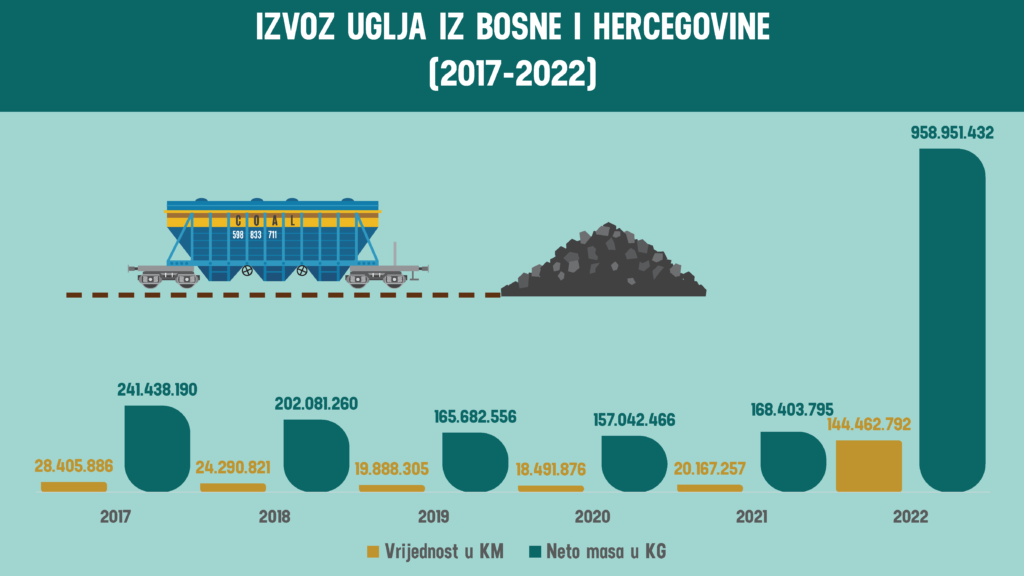
Mass coal export from Bosnia and Herzegovina to Serbia began last year due to the energy crisis and drastic price jump on the world market, and according to data that TI BiH obtained from the Indirect Taxation Authority, the export quantity increased 5.7 times, and the export value jumped from 20 to 144 million KM.
However, coal from BiH was sold on average for 150 KM/t, which is significantly lower than the prices that were current on the world market at that time.
RMU Banovići responded in June this year that they sold 194,724 tons of coal on the foreign market, at an average price of 121 KM. Among other public enterprises, RMU Breza states that they exported 5,358 tons (walnut type) at a price of 175 KM/t and another 50 tons (cube type) at a price of 180 KM/t. RMU Kakanj claims they did not export coal, while other mines owned by Elektroprivreda BiH have not yet provided this information.
Besides public enterprises, among the largest coal exporters from BiH last year were also large mining companies in private ownership, but individual export data cannot be obtained from ITA.
Companies that have concessions for natural resource exploitation have been targeted by tax authorities for years due to suspicion that they report unrealistically low revenues in order to pay less taxes and lower concession fees, which are usually tied to revenue generated from concession activities.
TI BiH pointed to this problem in an analysis of the situation in the field of concessions in BiH, and also published the first concession registry because data availability is an important segment of corruption prevention in this area.