One doesn’t need to be a particular expert on the European integration process, nor on the situation in Bosnia and Herzegovina, to conclude that Bosnia and Herzegovina’s European path is dead. No tragicomic optimism from certain political leaders in Bosnia and Herzegovina, nor praise from Euro-bureaucrats can change this fact.
Not only is there no progress in meeting conditions and moving closer to the EU, but Bosnia and Herzegovina is actually moving away from the EU. To argue this thesis, one only needs to see what a tragicomic little despotism Milorad Dodik, its absolute owner, is making of Republika Srpska by introducing criminalization of defamation and laws on foreign agents. This, of course, has nothing to do with the EU, but rather with his favorite Russia. Indeed, he doesn’t even hide it.
In the past five years up to 2023, the Parliamentary Assembly of Bosnia and Herzegovina has adopted, in words and numbers, 29 laws. When we subtract the budget laws that are adopted automatically and cosmetic laws on amendments with just a few articles, we arrive at a figure of 2 laws per year. During the same period in the past 5 years, Serbia, for example, has adopted over 1000 laws. Even if we take into account the difference in competencies between the Parliamentary Assembly of Bosnia and Herzegovina and the National Assembly of Serbia, the difference is striking and speaks for itself.
This pitiful performance of adopting a few so-called European laws hastily cobbled together at the last minute only confirms the thesis that the European path is dead. The way they were passed, without respecting and fulfilling the elementary level of transparency and inclusiveness of the process, without respecting elementary standards in the areas they relate to, adopted in a way that political leaders first meet, and then on the same day the Parliament is convened and MPs gathered to vote, confirms that this is a complete farce.
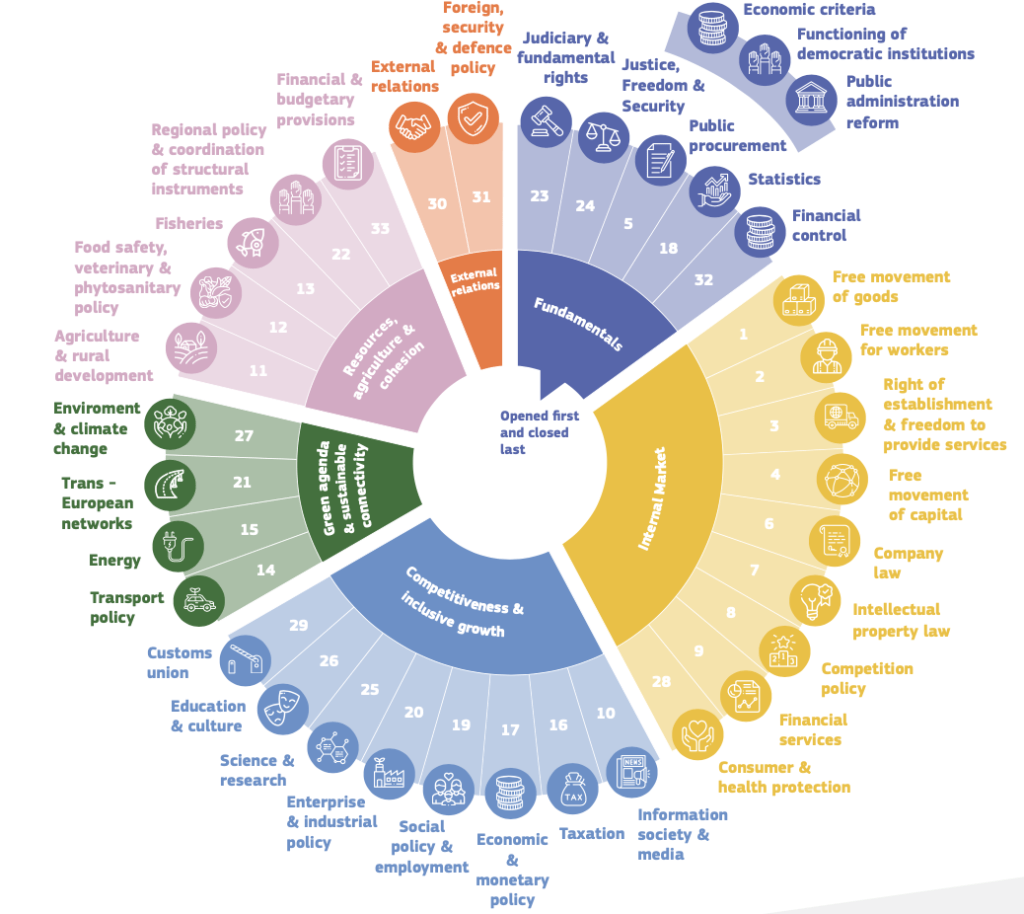
Comparatively speaking, in comparison with other countries in the EU accession process, Bosnia and Herzegovina, in terms of preparedness when evaluated according to European Commission reports, is even behind countries that have only recently received the prospect of full EU membership – Ukraine, Georgia, and Moldova. As shown in the comparative table below, which provides an overview of the level of preparedness across all chapters, Bosnia and Herzegovina is in almost all chapters either in an early stage of preparedness or an initial stage with a certain level of preparedness.

If we zoom in on the state of areas that the EU treats as priorities (fundamentals) such as the functioning of democratic institutions and public administration reform, the situation is even worse. For years, Bosnia and Herzegovina, as the third most corrupt country in Europe right after Russia and Ukraine, has had no anti-corruption strategy. Regarding public administration reform, Bosnia and Herzegovina struggled for years to adopt a strategy, then struggled for years to adopt some kind of supervisory and monitoring structures, only for this year’s report on strategy implementation to show that the degree of fulfillment of measures from the strategy is at the level of 14%. Therefore, it is not surprising that the EC assesses that Bosnia and Herzegovina, after two decades, is in an early stage of reform or preparedness for EU membership. The situation is similar with the Justice Sector Strategy, which has been in preparation for years, and it is, of course, pointless to talk about implementation.
All in all, acknowledging the existing state, without deception and phantom optimism, should be some kind of starting point for beginning to think about how to get out of this situation.
Einstein long ago asserted that doing the same thing and expecting a different outcome is a reliable sign of insanity. We have persistently tried and are still trying precisely that, but we have also empirically convinced ourselves of the accuracy of Einstein’s assessment. Perhaps it’s time to try differently. This is by no means about the EU having no alternative; it does, as everything has an alternative, but each of them is immeasurably worse. We see this from our own experience; we are living one such possible alternative that can be characterized as a general decline of the state and society. Recent ramblings about joining BRICS are not even worth commenting on.
Therefore, the preliminary question before delving into technical matters about the accession process, methodology, chapters, is what do we actually want as a society. The last two decades of the EU accession process have gone to waste. Do we have time to squander the next two in the same way? This should be the fundamental question in the discussion about the future of this country.