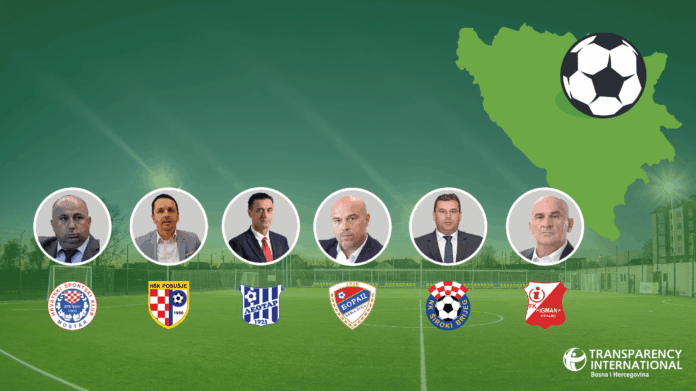
In the management of six football clubs from the Premier League of Bosnia and Herzegovina that receive significant public funds, there have been individuals for years who hold positions in executive and legislative authorities, directly violating conflict of interest laws. Therefore, Transparency International in BiH (TI BiH) has requested a response from relevant institutions because HSK Zrinjski, FC Leotar, HSK Posušje, FC Borac Banja Luka, FC Igman, and NK Široki Brijeg have appointed public officials to their management, disregarding the fact that they hold legally incompatible positions.
The position of chairman of the board of HSK Zrinjski has for years been held by former FBiH Government Minister Denis Lasić, although the Law on Conflict of Interest in FBiH Government Bodies explicitly prohibits officials from being authorized persons in associations financed from any level of government budget in amounts exceeding 50,000.00 KM annually for cultural and sports associations. Given that this club has repeatedly received public funds from the Federal Ministry of Culture and Sports, City of Mostar, Ministry of Civil Affairs BiH, and received over 200,000 KM annually through tenders from Elektroprivreda HZHB alone, it is evident that Lasić, as the club’s leader, has been in a conflict of interest for years. Unfortunately, since 2013, there has been no competent body in the Federation of BiH to implement this law, but it remains in force, which should have been considered by institutions approving funds and making appointments, so TI BiH has requested official explanations from them.
Almost the same case is with HSK Posušje whose president Dario Sesar is simultaneously the Deputy Prime Minister and Minister of Economy of West Herzegovina Canton (WHC) and also legally cannot head a sports club that receives budget funding exceeding 50,000 annually. Nevertheless, this club received about 77,000 KM from the WHC Government where the club president serves as minister, thus his own government placed him in a conflict of interest. Additionally, this club receives public funds through Elektroprivreda HZHB tenders, and TI BiH has requested explanations from the Government and response from the WHC Assembly’s Committee for Justice, Administration, Human Rights, Freedoms and Gender Equality.
TI BiH has also filed a complaint with the RS Conflict of Interest Commission against the former president of FC Leotar from Trebinje, Gordan Mišeljić, who held four positions last year and is in conflict of interest on three grounds. This club received half a million KM from the City of Trebinje budget, and Mišeljić serves as a city assembly member and could directly influence this decision. The RS Law on Prevention of Conflict of Interest prohibits elected officials from heading associations receiving more than 100,000 KM annually, and what’s completely absurd is that the Commission didn’t establish a conflict of interest in this case because the City of Trebinje didn’t provide official data about how much money was paid to this club, although this information was publicly announced and was boasted about by the Mayor of Trebinje and other officials. TI BiH has initiated legal proceedings in this case, and it’s important to note that Mišeljić is in conflict of interest on two more grounds as he also holds positions as director of Hidroelektrane na Trebišnjici and member of the supervisory board of Hidroelektrana Dabar, both positions being incompatible with his city assembly position.
TI BiH has also reported the new board president of FC Borac Banja Luka Milan Tegeltija who simultaneously serves as legal advisor to Republika Srpska President Milorad Dodik and legally cannot be part of the club’s management that receives public funding. Given that the RS Government, according to media reports, has paid two million marks this year alone to cover the club’s debts, it is evident that Tegeltija is in a conflict of interest, so TI BiH has filed a complaint with the competent Commission.
Also, heading the assembly of NK Široki Brijeg is Federation of BiH Parliament House of Representatives member Dario Knezović who held this position in the previous term as well. Given that this club has repeatedly been financed with public money from the City of Široki Brijeg budget, Federal Ministry of Culture and Sports, and WHC Government, it is evident that Knezović is in conflict of interest under current law. Therefore, TI BiH has addressed the FBiH Parliament’s Commission for Human Rights and Freedoms Protection and the Parliament’s Ethics Commission as the Code of Ethics requires parliamentarians to step down from positions when conflicts of interest or incompatibility of functions arise under current law, and the ethics commission has authority to impose certain measures.
The sixth such case involves FC Igman Konjic whose president Đahid Muratbegović is also director of public company Igman Konjic, and served as city council member until 2021 when the council approved public funds to this club exceeding the permitted 50,000 KM, putting him in conflict of interest. TI BiH has requested information from the City Council about whether Muratbegović recused himself from voting on these decisions, and data about financial support to this club was requested from public company Igman Konjic. However, it should be noted that this public company has previously refused to provide data about financial allocations and comply with the Freedom of Information Act, citing protection of defense industry data.
Particularly problematic in all these cases is that the same individuals simultaneously hold positions in authorities deciding on fund allocation and head clubs where they decide on spending that public money, while the public has for years been shaken by scandals regarding misuse of public funds for these purposes. It should be noted that the purpose of the Law on Prevention of Conflict of Interest is precisely to prevent public officials from pursuing private interests or favoring organizations with which they have business, political, or other connections through their official positions.
Unfortunately, this practice has existed for many years, and almost all institutions completely ignore the existence of conflict of interest laws. Therefore, TI BiH, in addition to complaints and letters to competent institutions, has repeatedly appealed to key decision-makers to adopt the Law on Conflict of Interest in FBiH and significantly improve laws at BiH and Republika Srpska levels. Unfortunately, so far, only Brčko District has adopted a law aligned with international standards, while at other levels there are even attempts to adopt solutions worse than existing ones. Besides law violations, it’s certainly concerning that political parties maintain control over sports clubs, as for years individuals connected to politics and government bodies who influence public money allocation have been appointed to club management positions.