
Throughout Bosnia and Herzegovina last year, approximately 125 million BAM in concession revenues was collected, according to the budget execution report of all levels of government, and these revenues are 3 million lower than in 2021, according to data from the concession register published by Transparency International in BiH. The share of these revenues in total current revenues fell to only 0.9%, even though enormous natural resources are exploited in BiH, as numerous concessionaires accumulate large debts. On the other hand, most government authorities do not have established concession registers, do not publish or refuse to provide data on collection and concessionaire debts, which creates enormous corruption risks.
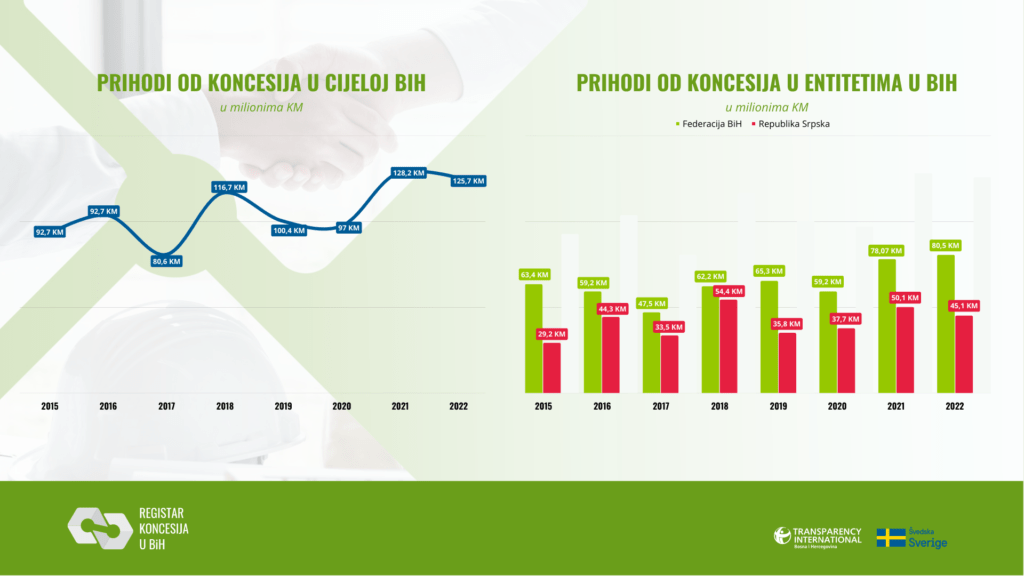
TI BiH has so far obtained data on 735 concessions and 528 concessionaires from all levels of government in BiH, and the data has been published so that the public can monitor the situation in this area, which is the first step in preventing corruption and abuse of public resources. It should be noted that numerous authorities provided incomplete data, and the Government of Sarajevo Canton, the Government of Canton 10, and the Government of the Republic of Srpska did not provide information on individual payments and debts of concessionaires.
Only 95 concessionaires for whom the authorities provided data currently owe about 14.1 million KM, but this amount is much higher, given that data on the debts of numerous concessionaires are concealed and natural resources are exploited without concluded contracts, which is why claims from concessions are not recorded on all grounds.
Due to numerous irregularities, reports were submitted to the inspection and prosecution.
In recent years, a large number of concessionaires have avoided paying obligations, and due to weak control by the competent authorities and concealment of data, everything went without consequences and public attention. TI BIH, after receiving the information, also submitted the first reports to the competent authorities, and a criminal complaint was submitted to the competent prosecutor’s office against those responsible in the Government of the Central Bosnia Canton for failing to initiate procedures for collecting suspicious and disputed claims from concessionaires, worth 1.7 million KM, causing significant damage to public revenues.
Although a large number of concessionaires did not pay obligations, and some have since been shut down, the Ministry of Economy of the Central Bosnia Canton did not terminate contracts, while the Ministry of Finance did not initiate collection procedures through the activation of promissory notes, and the need for the competent authorities to investigate the actions of those responsible in this case was also pointed out by the Audit Office of BiH.
It should also be noted that for years the exploitation of natural resources without a concluded contract has been tolerated, and due to observed irregularities, TI BIH has so far submitted 10 reports to inspection bodies. In two cases, inspectors banned the exploitation of geothermal water due to the lack of a permit from the competent ministries, and in one case it was found that the company did not have a concession or a license to perform the work.
It should be particularly noted that illegal exploitation of gravel and sand is widespread, even though there is not a single active concession contract in this area. Excavation from riverbeds is carried out with the acquisition of water consent for cleaning the riverbed, and this only serves as a cover for illegal exploitation without compensation.
Auditors suspect the truthfulness of the reports published by concessionaires.
In addition to non-payment of fees, the biggest problem is monitoring the implementation of contracts, as there are suspicions that numerous concessionaires do not report real revenues or quantities of exploited natural resources, and it is precisely on this basis that the concession fee is charged. The largest number of concessions, 47%, were awarded in the field of mineral raw material exploitation, where there has been no significant increase in collection for years, despite the fact that the prices of almost all mineral raw materials on world markets have multiplied in recent years.
For example, the prices of aluminum and bauxite ore on the world market increased by over 140% from 2015 to 2022, but concession fee collections have not increased, as the six largest bauxite mines in BiH do not show any significant revenue increase, which is cumulatively 7.6% lower today than in 2015.
Also, the price of iron ore on the world market increased by 210% from 2015 to 2021, but the revenues of the largest iron ore mine, Arcelor Mittal Prijedor, have not increased significantly in recent years. The RS Tax Administration, in its response to TI BiH, states that this entity was assessed additional tax liabilities of 6.4 million BAM for the period 2011-2013 and another 3.2 million BAM for the period 2015-2021 due to the effect of transfer prices at which it sells ore to the Zenica Steelworks.
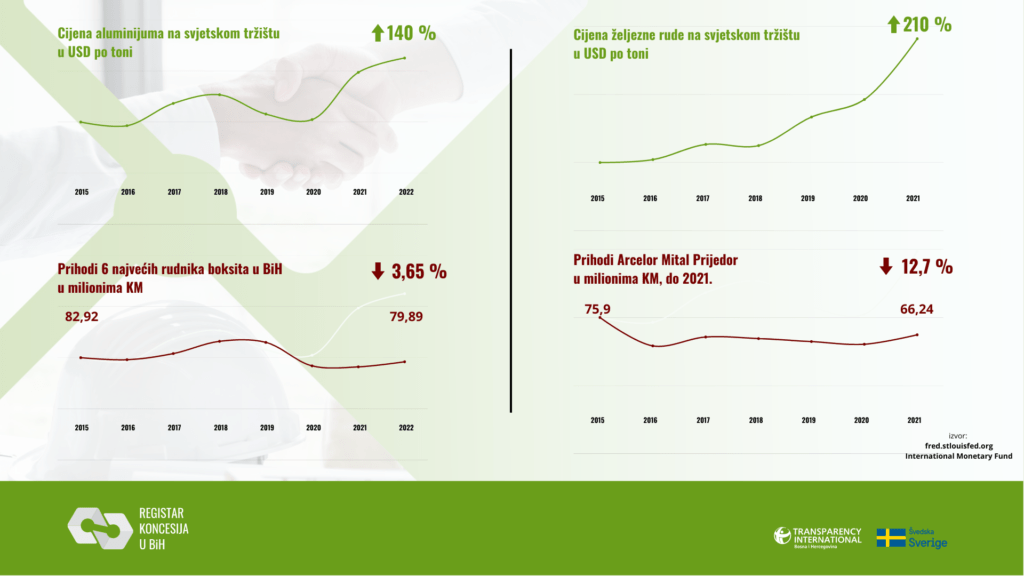
A similar trend is visible with other concessionaires who exploit significant natural resources because the revenues of concessionaires, and thus the payments of concession fees, remain at the same level, even though the prices of almost all resources have significantly increased. This was pointed out earlier by the Main Audit Office of RS.
–The absence of oversight functions is also present where the risks of irregularities, falsely reported quantities, unprofessional exploitation, and fraud are greatest. Revenues and public interest in this regard depend on what the private concessionaire reports to them in geodetic surveys and financial reports. The Ministry cannot provide the public, the profession, and the RS Government with a guarantee or argument that the quantities and revenues of concessionaires reported in this way are truthful. Although there are significant technical-technological possibilities for quality oversight of exploitation, the Ministry does not plan, contract, or establish professional oversight mechanisms, as stated in the report.
A similar problem in the Federation of BiH was pointed out by the Audit Office of FBiH institutions, which in its latest report for Canton 10 concluded that geodetic surveys on the basis of which revenue collection was supposed to be carried out, were not conducted due to bad weather conditions, so the Ministry calculated based on concessionaire data.
Lack of control is also present in other areas, and the example of the Municipality of Neum should certainly be highlighted, which granted a parking fee collection concession to the company Bakus d.o.o. even though, according to the audit opinion, the conditions for this did not exist, as these services were under the jurisdiction of the local utility company, and the Municipality did not obtain the consent of the cantonal ministry for the award. This lucrative business in a tourist destination with a large number of tourists, which according to media estimates has 1,700 parking spaces, was granted for a fee of only 81,000 BAM per year, which, according to the audit findings, is not paid regularly.
Auditors also conclude that it is questionable that this private company was given public authority to collect and impose fines, of which the Municipality receives only 20%, and the rest is retained. In addition, federal auditors could not determine that the public interest is protected in the best way and that the Municipality receives a realistic amount of revenue.
–We found that the Municipality monitored the collection of parking revenues through the execution of payments to the deposit account without accompanying records of the company Bakus d.o.o. The contract determined the locations for vehicle parking, but the total usable parking area was not specified, which is why the amount of the concession fee cannot be determined, as stated in the audit report.
TI BIH requested data from the Municipality of Neum on the method of calculating the concession fee, concessionaire payments, and debts, but the municipal authorities have not provided a response for a month and a half.
Transparency in the allocation of concessions
It is important to note that in the procedure of awarding concessions, public bidding is bypassed, and the data obtained by TI BiH show that 63% of concession contracts were awarded following a self-initiated offer by the concessionaire. As a result, numerous concessions have been awarded to companies with questionable credibility, as the data obtained by TI BIH show that out of the total number of concessionaires, 104 have no employees or only one employee, yet they generated revenues of over 22 million KM.
Due to the lack of transparency in the allocation of concessions, control, and collection of public revenues, TI BIH has repeatedly warned that it is necessary to enable the public to monitor the situation in the field of concessions through the public publication of registers and all data on the collection of concession fees.
TI BiH has been advocating for years for the harmonization of the legal framework at all levels in BiH with the Concessions Directive and other significant EU regulations and bringing the concession system under a unified public procurement system. Therefore, all principles and provisions of the Public Procurement Law in terms of transparency, e-procurement, conflict of interest, and legal protection should also apply to concessions. This would enable the maintenance of a unified electronic register, unified concession plans, and fee calculation methods.