We know that corruption depletes resources, endangers the environment, causes poverty, but it also has the capacity to take lives!
We have witnessed numerous examples indicating that corruption can be deadly. Let’s recall 2013 and the collapse of the Rana Plaza factory in Bangladesh where 1,134 people died in one building because warnings were ignored and workers were forced to enter a building full of cracks. Or the explosion in Beirut in 2020. These are direct results of the actions or inactions of those responsible in the face of long-standing corruption and mismanagement in the port, which caused the death of 218 people.
According to a study published on the anniversary of the Haiti earthquake, it was calculated that 83% of all deaths due to building collapses in earthquakes over the past 30 years occurred in highly corrupt countries. The answer to why earthquakes above magnitude 7 cause many more deaths in countries like Indonesia, China, Iran, and others, truly lies in corruption. Poorly constructed buildings, non-enforcement of regulations, use of low-quality materials, improper construction sites, etc., are signs of serious failures by the authorities.
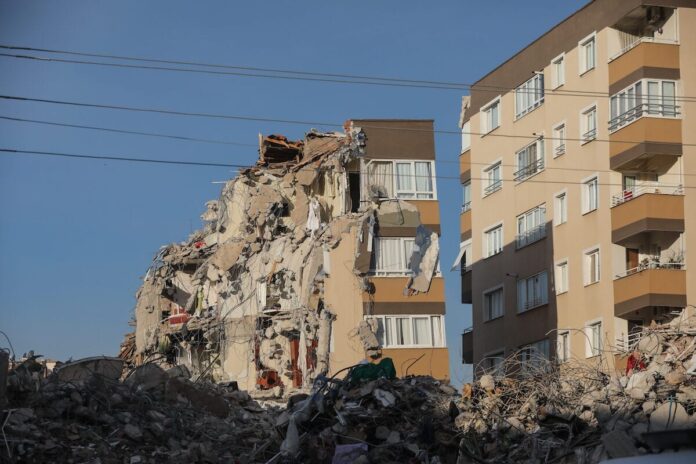
The latest example of an earthquake that turned into a catastrophe with deadly consequences is the recent earthquake in Turkey that occurred on February 6, 2023. The ground shaking with a magnitude of 7.7 affected an area inhabited by 13.5 million people. So far, the number of casualties has reached 31,000 (and is still rising) while 120,940 housing units have collapsed or been damaged. Turkey had already experienced another deadly earthquake in 1999 in which 18,373 people lost their lives.
It seems that important lessons have not been learned in the meantime, but what actually happened in these 18 years?
The construction industry has been booming in the last 20 years of AKP government. Although construction is known as one of the most corrupt industries worldwide, in Turkey it has flourished along with large concessions for roads, airports, bridges, hospitals, etc., granted by the government of this country. However, roads and airports in earthquake-prone areas, some of which were thoughtlessly built on seismic zones, collapsed along with buildings housing important public sector institutions, such as hospitals. Ironically, even the building housing AFAD (Disaster and Emergency Management Authority) was among the buildings that collapsed.
There are many reasons that can be linked to the current tragedy, such as the greed of contractors, lack of control, impunity for previous failures, conflicts of interest between construction companies and supervisory bodies, and the like. These are all different forms of corruption, which is very widespread in this country. Let’s remember that Turkey is one of the countries that has
Since Turkey is also a country at very high risk for earthquakes, it is clear that urgent fundamental reforms of the legal framework are needed. After the 1999 disaster, new building regulations for earthquake-resistant construction came into force, but their implementation is inadequate. The fact that a large number of newly constructed buildings collapsed in this earthquake can only describe their implementation and the extent to which they are respected. Also, it is a well-known fact that spatial planning regulations have often been changed due to populist measures by the highest state bodies and local governments.
The latest measure with catastrophic consequences for the entire system was the adoption of regulations that amnesty illegal construction and construction outside the regulatory plan, which came into force in 2018 despite strong opposition from experts and civil society representatives. This amnesty regulation provided for the legalization of illegally constructed buildings by simply paying a fee to the government. According to the Ministry of Spatial Planning and Construction, nearly 9 million people paid the fee. More importantly, the process itself did not include any seismological checks or compliance with building standards in earthquake-prone areas, and this responsibility was shifted to the owners of illegally constructed buildings. Even buildings that had been issued demolition notices due to non-compliance were included in this process, which obviously proved to be a fatal mistake.
Another specificity is the special fee collected for special purposes from the Turkish people after the 1999 earthquake. As former finance ministers have stated, this money was used for other public works, namely the construction of roads, airports, and hospitals which, unfortunately, were among the first to be hit by the earthquake and were destroyed.
Disasters are times when good governance capabilities are put to the test as a key element for the state’s ability to cope with a crisis. Institutions weakened by appointments not based on competence lose the capacity to perform basic functions. And that is exactly what is currently happening with the institutions responsible for rescue and distribution of humanitarian aid in Turkey.
Thousands of people on the ground claim that rescue services did not respond in time and lack organizational skills, which has cost many lives. Allegedly, with the recent reduction of the state budget for 2023, funds for AFAD’s operation were also
Natural disasters may be inevitable, but corruption, negligence, and poor management are not.
In Turkey, there is a widespread understanding that “it’s not the earthquake that kills us, but the buildings”. It’s time to change that to “it’s not the earthquake that kills us, but corruption…”
The author of the text is E. Oya Özarslan, Transparency International Turkey
https://seffaflik.medium.com/corruption-kills-turkey-earthquake-7884640db389