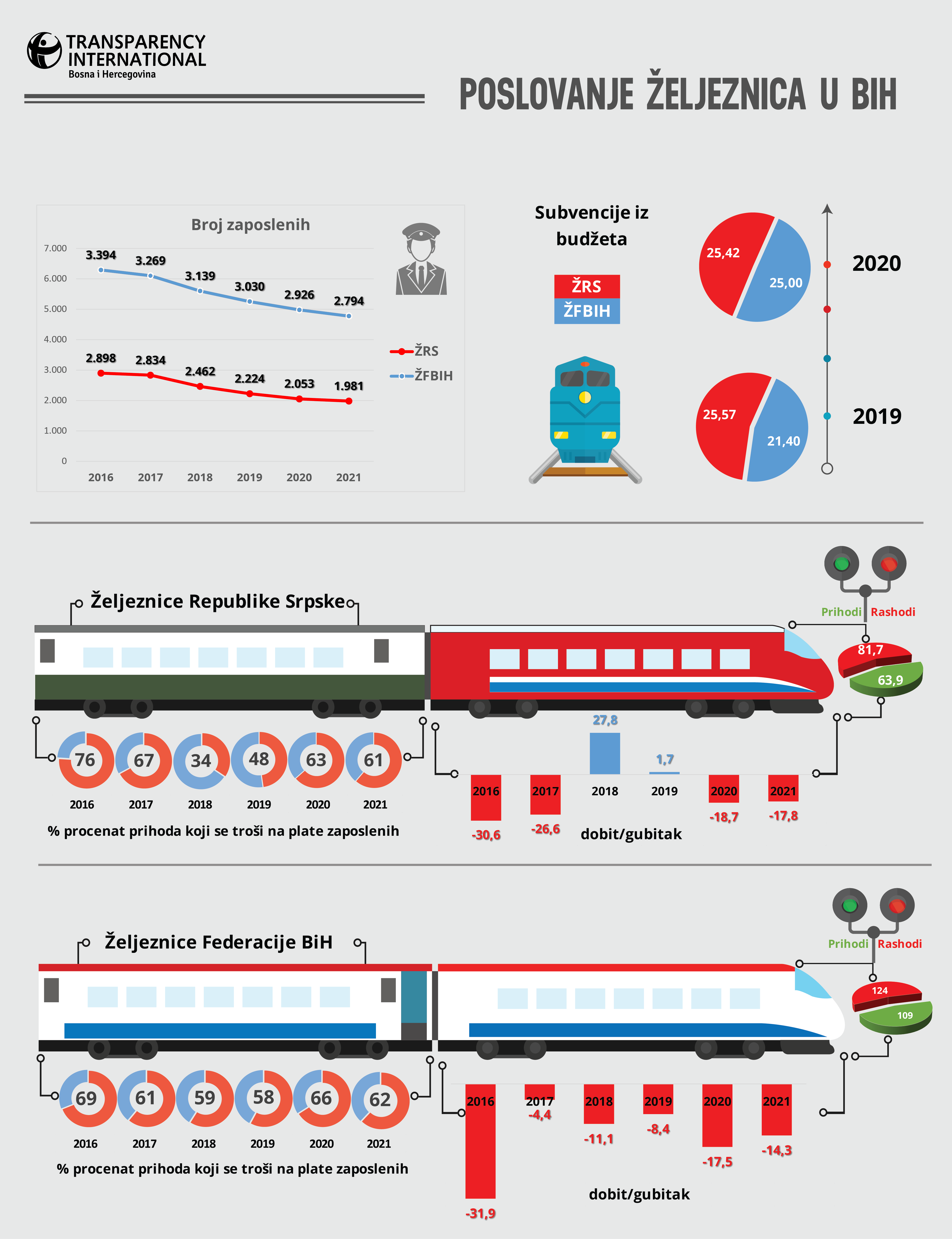
The two railway companies in Bosnia and Herzegovina continued to accumulate millions in losses despite entering a process of reducing the number of employees. Last year alone, RS Railways incurred a loss of 17 million KM, and the situation is no better in FBiH Railways, which operated with a deficit of 14 million KM.
Long-standing problems of uncontrolled employment will continue to burden FBiH Railways (ŽFBIH) and RS Railways (ŽRS) for a long time, as well as taxpayers, as 25 million KM is allocated annually from entity budgets for subsidies to these two public enterprises. According to the World Bank’s assessment, these subsidies are high compared to the EU average but are insufficient for the normal functioning of these companies.
An analysis by Transparency International in BiH (TI BiH) shows that ŽFBIH has about 600 fewer workers than in 2016, while in the same period, the number of employees in ŽRS decreased by over 900. Nevertheless, both companies spend over 62 percent of their income on employee salaries and, despite significant budget support, still cannot cover their obligations.
An additional problem is that both companies have recorded a decrease in revenue in the last two years, and ŽRS, despite having excess workers, must employ new ones due to the inadequate workforce structure, which they are trying to improve through requalification.
RS Railways pay restructuring consultants over 600,000 KM annually
The World Bank, in its earlier study, stated that ŽRS has excess workers, which was a result of the government’s employment creation policy, so government support will be necessary to bring the number of workers to the right level.
The World Bank supported the restructuring of ŽRS with a loan of about 51 million euros, and the plan is still to spend the money on settling debts to workers and the state, reducing the number of workers, and organizational restructuring.
As a result, numerous consultants have been engaged, and according to the audit report, ŽRS spent 626,452 KM on consulting services in 2020. Given the large number of reports received by TI BiH suspecting the purposefulness of spending these funds, TI BiH has requested the company management to provide all contracts and names of consultants engaged. The amount spent on these services was further increased last year when the Montenegrin company
While restructuring is ongoing, ŽRS’s obligations on short-term and long-term loans have exceeded 300 million marks, and over 25 million marks are allocated annually for the normal functioning of this company.
Regardless, the RS Auditor states that the company management did not reduce the salaries of directors and executive directors by 10% in 2020 in accordance with previous conclusions of the RS Government. An additional problem is that the managers of this company are politically appointed without public competition and in accordance with coalition agreements in Republika Srpska. The auditor states that employment contracts with directors and executive directors are concluded for a period of two months (starting from March 14, 2017), and the company management (general director and executive directors) have not been appointed through public competition since then, as prescribed by the Law on Public Enterprises.
FBiH Railways: No plan for the future
ŽFBIH losses further increased in 2020 and 2021 despite a reduction in the number of employees and salary costs. This was also influenced by a decrease in company revenues, and the Audit Office for the Institutions of FBiH states that the company bodies (Assembly, Supervisory Board, and Management) have not prepared a strategic plan for sustainability and business improvement that would be implementable in practice.
FBiH Railways have been incurring losses in operations for years, with extremely unfavorable financial indicators primarily related to the risk of illiquidity and over-indebtedness. Although salary costs and other personal income in the total cost structure amount to 56.5%, the Company has not reviewed the systematization of job positions with the aim of rationalizing costs and efficient performance of tasks, states the latest report of the Audit Office for FBiH Institutions.
The auditor assesses that due to the untimely resolution of accumulated problems and years of losses, resulting from insufficient, inadequate, and systemic support from the Federation of BiH and the passivity of management bodies, exceptionally large obligations have been created.
In addition to the problems of excess employees and poor business performance, the auditor criticizes the company management for avoiding public procurement procedures, noting a significant number of identical procurements that were split to be concluded through direct agreement, spending over 160,000 KM in this way. According to the auditor, 104,710 KM was paid without tender to the company SMAL KOMERC d.o.o. Sarajevo for the procurement of various oils, Jasmin M Žepče 19,644 KM, Unilab Sarajevo 25,634 KM, TEKNOXGROUP BH 10,803 KM.
ŽFBIH has reduced the number of employees, but this is still not enough because since 2018, the company’s revenues have decreased by 11 million, while only about 3 million less is spent on salaries than then. The Federation of BiH has so far allocated slightly lower subsidies than Republika Srpska, around 21 million KM, but in 2020 they rose to 25 million.
Long-standing problems of excessive employment in both railway companies in BiH continue to cause significant losses and increasing pressure on public finances, as both companies accumulate tax debts, and ŽRS cannot service obligations on foreign loans taken over by the state.